
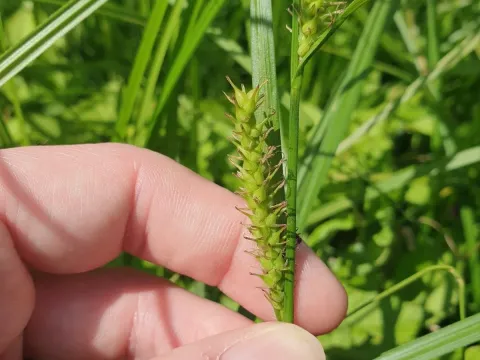
Miyabe sedge
Carex miyabei
Miyabe sedge (Carex miyabei) is a perennial herbaceous plant belonging to the Cyperaceae family. Originating from the Far East, specifically Japan, this species has adapted to thrive in wetland ecosystems, riverbanks, and areas with high soil moisture content.
What the section contains
Miyabe sedge
The plant exhibits remarkable physiological adaptation to hydromorphic soils, including peat and clay-based substrates. It is highly valued for its ability to persist in waterlogged environments where typical agricultural crops would fail due to root asphyxiation.
Botanically, Carex miyabei is characterized by the formation of dense tussocks and a strong, fibrous root system. The stem is typically triquetrous, typical for the Cyperaceae family, and the leaves are narrow and coriaceous, providing structural resilience against environmental stress.
Regarding climatic requirements, the species favors cool to temperate conditions with high atmospheric humidity. It requires consistent water availability throughout the growing season to maintain its vigor and biomass production levels in field conditions.
Agricultural and environmental utility of Miyabe sedge includes soil erosion control, phytoremediation of polluted water bodies, and the creation of vegetative buffers. It serves as an essential species for maintaining biodiversity and landscape stability in marshy territories.
The primary pathological threats include various species of fungi causing leaf rust and smut, especially in poorly ventilated environments. To prevent these diseases, proper spatial planning and maintenance of optimal density are recommended for all cultivated plots.
Insect pests that target the root and basal stem sections pose a risk during the early growth stages. Monitoring and maintaining soil health are critical strategies to prevent infestation and ensure the long-term survival of the crop in its habitat.