
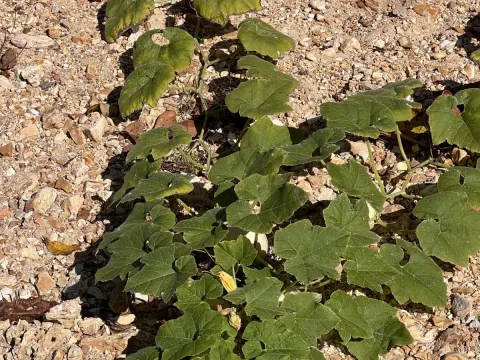
Texas gourd
Cucurbita texana
The Texas gourd (Cucurbita texana) belongs to the Cucurbitaceae family and is native to the central and eastern parts of Texas, USA. It is primarily recognized as a wild relative of cultivated squash and pumpkins, often found in alluvial soils.
What the section contains
Texas gourd
This species is highly heat-tolerant and thrives in sunny, open locations with well-drained soil. It requires a long, warm growing season to reach maturity, making it well-adapted to subtropical environments.
When cultivating Cucurbita texana, it is essential to provide sufficient space, as the plant is a vigorous climber with long vines. It prefers soil rich in organic matter, which supports the intensive vegetative growth typical of this species.
Water management is crucial during the early stages of development and flowering. While it possesses some drought tolerance due to its deep root system, consistent moisture availability significantly improves its growth rates and fruit set.
In agricultural and botanical research, this plant is primarily valued as a germplasm source. Breeders utilize its robust genes to improve disease resistance in commercial squash varieties, making it an essential subject for crop improvement studies.
The Texas gourd is susceptible to common cucurbit diseases such as powdery mildew, which can significantly reduce the photosynthetic capacity of the leaves during late summer months.
Downy mildew is another major threat, particularly in humid climates. It causes rapid defoliation and requires a strict prophylactic program to maintain the health of the plant throughout the season.
Pest pressure often includes cucumber beetles, which not only consume leaf tissue but can also act as vectors for serious bacterial wilt diseases that can wipe out an entire population.
Aphid infestations are also frequently observed. These insects cause leaf curling and transmit viruses that severely limit the development of the plant and the quality of the fruit produced.
Effective management strategies rely on a combination of crop rotation, the use of resistant varieties, and timely intervention with appropriate protective measures to minimize economic losses.