
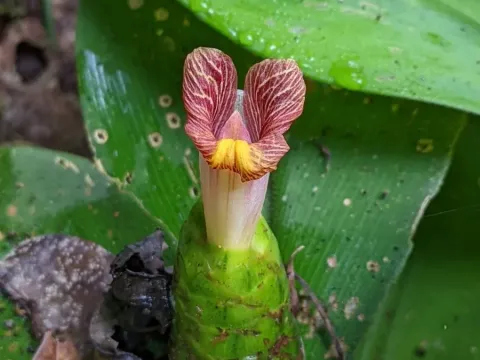
Costus malortieanus
Costus malortieanus
Costus malortieanus is a perennial herbaceous plant belonging to the Costaceae family. It is native to the tropical rainforests of Central America, specifically regions in Costa Rica and Nicaragua, where it thrives in shaded, humid environments.
What the section contains
Costus malortieanus
Botanically, this species is distinguished by its large, elliptic, velvety leaves arranged in a spiral pattern along the stem. Its unique soft texture and lush green appearance make it a highly desirable specimen for botanical collections and interior landscaping.
To ensure optimal growth, the plant requires stable tropical conditions with temperatures ranging between 20 and 26 degrees Celsius. It is highly sensitive to cold drafts and sudden thermal fluctuations, which can cause significant physiological stress to the plant.
Soil requirements dictate a well-draining, moisture-retentive substrate rich in organic matter. A mixture of peat, perlite, and decomposed leaf mold is ideal for providing the necessary aeration and nutrition for the plant's developing root system.
In ornamental horticulture, Costus malortieanus is primarily used as an indoor potted plant or as a decorative ground cover in conservatory settings. Its ability to tolerate low-light conditions makes it an excellent choice for shaded architectural spaces.
The primary threat to the health of Costus malortieanus is root rot caused by waterlogged soil. Proper drainage and careful irrigation scheduling are essential to prevent the degradation of the root system and the subsequent development of fungal infections.
Pest infestations, particularly spider mites, are common in environments with low air humidity. These mites thrive in dry conditions and can cause severe damage to the velvet foliage if left untreated for extended periods.
Management of pests involves a combination of mechanical cleaning and the application of appropriate acaricides. Maintaining a high humidity level through misting or humidifiers is a proactive way to discourage mite colonization.
Fungal diseases, such as leaf spot or stem rot, may occur if the plant is kept in an environment with poor air circulation. Improving ventilation and maintaining cleanliness around the base of the plant are vital for disease prevention.
Regular monitoring of the underside of the leaves is recommended to identify early signs of infestation or infection. Early intervention with suitable fungicides or insecticides can prevent widespread damage to the entire plant.