
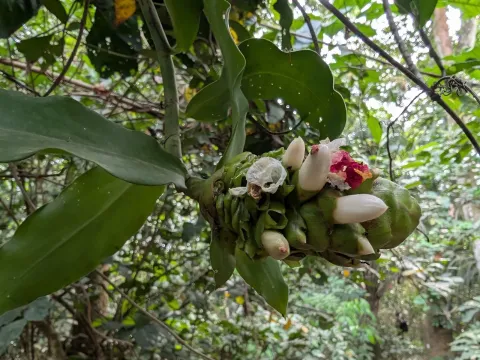
Costus lucanusianus
Costus lucanusianus
Costus lucanusianus is a tropical perennial herbaceous plant belonging to the Costaceae family. It is native to the rainforest regions of West and Central Africa, where it thrives in shaded, humid environments.
What the section contains
Costus lucanusianus
The plant requires a tropical climate with temperatures consistently above 20°C. It is extremely sensitive to frost and cold winds, making it suitable only for specific agro-ecological zones with high rainfall or controlled greenhouse environments.
Soil requirements focus on high organic matter content, excellent drainage, and a slightly acidic to neutral pH level. Stagnant water around the rhizomes must be avoided to prevent rot and root disease.
The agronomic management of this culture involves partial shade cultivation. Direct sunlight can cause leaf scorching, while light intensity directly affects the flowering cycle and overall plant vigor.
Propagation is typically done through rhizome division during the dormant or early growth period. Proper spacing is essential to ensure adequate airflow and nutrient access for each individual plant.
Common pests include spider mites and aphids, which often thrive in warm, sheltered conditions. Regular inspection and the use of targeted biological control agents are effective management strategies.
Fungal pathogens such as leaf spot and various rots represent a constant threat in high-humidity environments. Improving drainage and thinning dense foliage can significantly reduce the incidence of these diseases.
Root-knot nematodes can seriously hinder root development, leading to stunted growth. Implementing a strict crop rotation schedule and using disease-free planting material are vital for long-term production.
Slugs and snails pose a risk to young, tender shoots during the early stages of development. Physical barriers or organic molluscicides are frequently utilized in commercial plantations.
Viral infections can be transmitted through sap-feeding insects. Controlling the vector populations and maintaining strict hygiene practices during harvesting and maintenance are the primary defense mechanisms.