
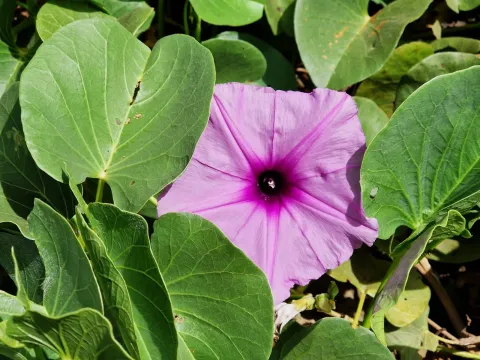
Ipomoea asarifolia
Ipomoea asarifolia
Ipomoea asarifolia is a perennial herbaceous plant that reproduces primarily through seeds or vegetatively by rooting along its trailing stems.
What the section contains
Ipomoea asarifolia
Sowing typically coincides with the beginning of the rainy season, which provides the necessary moisture for germination and early root development in tropical climates.
The seeds demonstrate excellent vigor, allowing for rapid colonization of land and the quick establishment of a dense vegetative ground cover.
For establishing larger plantations, the use of cuttings or transplants is highly recommended to expedite the growth cycle and achieve uniform stand density.
Optimal temperatures for planting range between 25 and 30 degrees Celsius, ensuring that the metabolic processes of the seedlings are not hindered during the initial growth phase.
Belonging to the Convolvulaceae family, this plant is highly adaptable to various soil types, even thriving in nutrient-poor, sandy soils commonly found in its range.
Ipomoea asarifolia is heliophilic, requiring abundant sunlight to support photosynthesis and the substantial accumulation of biomass needed for forage production.
While the plant shows significant drought resistance, supplemental irrigation during prolonged dry spells is essential to maximize overall yield and plant health.
The ideal soil pH for this culture is between 5.5 and 7.0, which allows for efficient nutrient uptake and minimizes potential heavy metal stress.
This species serves as an effective ground cover, preventing soil erosion and helping to manage weed competition due to its rapid growth and dense foliage.
The primary agricultural use of Ipomoea asarifolia is as a forage crop, providing a critical source of nutrition for livestock in arid and semi-arid regions.
Its biomass contains valuable protein and minerals, making it a reliable supplement for grazing animals during periods when traditional pastures are scarce.
Yield capacity can be significant, depending on local soil fertility and the frequency of moisture availability throughout the growing season.
By effectively utilizing marginal lands for this crop, producers can increase their total livestock carrying capacity without encroaching on prime arable land.
Strategic nutrient management, specifically low doses of nitrogen, can further boost foliage production and enhance the recovery rate after harvesting.
Fungal infections, such as leaf spots, are the primary disease threat, particularly when humidity levels remain high and air circulation within the canopy is restricted.
Common pests like aphids and spider mites can damage developing leaves, necessitating active scouting and integrated pest management practices to protect the crop.
Nematode infestations can become a persistent issue if the same ground is used for continuous cultivation, emphasizing the importance of crop rotation.
To mitigate these risks, farmers should focus on maintaining optimal plant spacing, which encourages better airflow and reduces the risk of moisture-related pathogens.
In cases of severe infestation, targeted biological or chemical treatments may be necessary to ensure the plant remains productive and healthy for forage purposes.
Harvesting is typically conducted by mowing the aerial parts, ensuring a sufficient residual height to facilitate rapid regeneration of the vegetation.
The ideal timing for cutting occurs during the peak flowering phase to ensure the foliage contains the highest concentration of digestible proteins.
Since the stems can be quite long and trailing, farmers often utilize modified mowing equipment to prevent the plant material from tangling in the machinery.
Post-harvest management should focus on minimizing drying time or utilizing the fresh biomass immediately to preserve the nutritional integrity of the feed.
Consistent harvesting practices prevent the stems from becoming too lignified and tough, thereby ensuring they remain palatable for various types of livestock.