
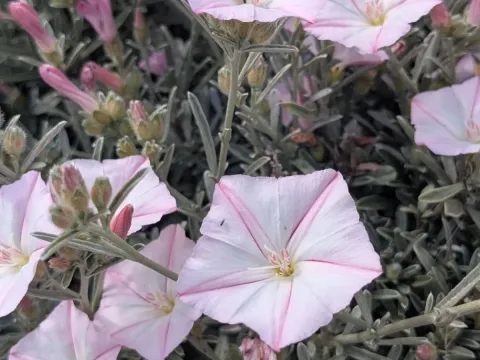
Olive-leaved bindweed
Convolvulus oleifolius
Convolvulus oleifolius is a perennial subshrub belonging to the Convolvulaceae family, known for its elegant foliage and distinct ecological preferences.
What the section contains
Olive-leaved bindweed
Propagation is typically achieved through seeds, which should be sown in a well-draining, sandy-loam medium to ensure successful germination and root development.
The sowing period is recommended for early spring, allowing the plant to establish its root system before the onset of the peak summer heat.
Seeds are placed at a shallow depth to ensure they receive adequate warmth and light, which are critical triggers for breaking dormancy.
Proper spacing is essential when sowing to allow for air circulation, which helps prevent the development of moisture-related issues early in the growth cycle.
Native to the Mediterranean region, this species thrives in full sun exposure and is highly adapted to arid and semi-arid climates.
The plant requires rocky or calcareous soils with excellent drainage, as it is highly susceptible to root rot in waterlogged or dense clay soils.
As a true xerophyte, it demonstrates remarkable resilience to drought conditions, maintaining its decorative value even during extended dry spells.
It prefers alkaline to neutral soil pH levels, mirroring the chemical properties of the soils found in its natural limestone-based habitats.
Temperature tolerance is a hallmark of this species, though it prefers consistent warmth and requires protection from extreme, prolonged freezing temperatures.
The most significant threat to the health of the olive-leaved bindweed is the presence of fungal infections, primarily caused by excessive soil humidity.
Spider mites represent the primary pest challenge, thriving in hot and dry environments where the plant's natural defenses might be momentarily reduced.
Root rot, often associated with poor drainage, can quickly devastate a population, making precise irrigation management the most important protective measure.
Integrated pest management strategies should focus on ensuring adequate plant spacing to facilitate airflow and minimize the buildup of humidity.
If infestation by aphids or mites occurs, the use of environmentally friendly horticultural oils or soaps is recommended to mitigate the damage to the foliage.