
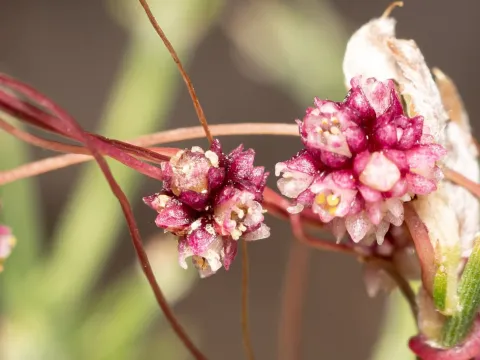
Palestinian dodder
Cuscuta palaestina
Palestinian dodder (Cuscuta palaestina) is a member of the Convolvulaceae family, specifically functioning as an obligate parasitic plant. Unlike standard agricultural crops, it lacks roots and true leaves, having evolved to steal water, carbohydrates, and minerals directly from host plants through specialized structures called haustoria.
What the section contains
Palestinian dodder
Originating from arid and semi-arid regions, this species is well-adapted to high temperatures and intense sunlight. It thrives in environments where host plants are abundant, utilizing its rapid growth rate to cover the host, thereby choking its development and intercepting sunlight.
Regarding soil requirements, the dodder is not dependent on soil nutrients because it derives its sustenance from the host. However, the germination of its seeds is triggered by chemical signals from the root or stem exudates of host plants, ensuring the parasite has a viable food source immediately upon sprouting.
The agrotechnical management of this plant involves rigorous hygiene practices. Since it has no agricultural utility, the primary focus is on eradication. Farmers must ensure that machinery used in infested areas is thoroughly cleaned before moving to unaffected fields to prevent the spread of seeds.
The resilience of Cuscuta palaestina is remarkable, as its seeds can remain dormant and viable in the soil for several years. This biological feature makes long-term soil management and crop rotation essential tools for minimizing the risk of re-infestation in agricultural zones.
The primary threat posed by Palestinian dodder is the severe reduction in crop yield and quality. By physically draining the host plant, the dodder causes stunted growth, wilting, and, in severe cases, the death of the crop, leading to significant economic losses for farmers.
Beyond nutritional competition, the dodder acts as a bridge for plant viruses. It creates an interconnected network between different plants, facilitating the rapid transmission of systemic pathogens that would not normally spread between non-adjacent crops in a field.
Management remains difficult because the parasite and the host share the same vascular system. Applying chemical control agents is often restricted to pre-emergence herbicides or controlled spot-burning, as systemic herbicides used to kill the dodder may also prove toxic to the crop being protected.
Biological control methods are currently being researched, focusing on specific insects or fungi that target dodder species. However, chemical and mechanical removal remains the standard practice, requiring labor-intensive monitoring during the early stages of crop development.
Integrated Pest Management (IPM) strategies for dodder include the use of trap crops that trigger seed germination without allowing the parasite to establish a permanent connection. This reduces the soil seed bank and allows for more effective subsequent control measures before the main crop is sown.