
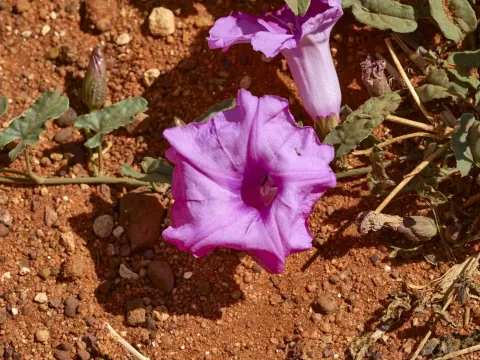
Mueller's morning glory
Ipomoea muelleri
Mueller's morning glory (Ipomoea muelleri) is a perennial herbaceous plant belonging to the Convolvulaceae family. It is a robust species native to the arid and semi-arid regions of Australia, specifically found in the Northern Territory and Queensland.
What the section contains
Mueller's morning glory
The plant thrives in well-drained, sandy, or rocky soils, showcasing high adaptability to nutrient-poor substrates. Its ability to survive in environments with limited annual precipitation makes it a candidate for sustainable land restoration projects in dry climates.
Optimal growth requires high levels of solar radiation and warm temperatures throughout the vegetation cycle. As a tropical to subtropical species, it does not tolerate frost, which serves as a major limiting factor for its geographical range of cultivation.
Agricultural management of this crop focuses on water-use efficiency and maintaining soil integrity. The root system is deep and expansive, allowing the plant to reach groundwater reserves inaccessible to many common annual crops.
Propagation is primarily achieved through seeds, which exhibit high viability in warm soil conditions. Ensuring proper spacing during sowing is essential to prevent intra-crop competition for moisture during prolonged dry spells.
Fungal pathogens represent the most significant threat to Ipomoea muelleri, particularly during periods of unseasonal humidity. Foliar blights can rapidly spread, leading to significant losses in vegetative biomass if not managed early.
Insects, particularly sap-sucking pests like aphids and whiteflies, often colonize the tender tips of the vines. These pests can transmit viral diseases that are difficult to manage once established in a field of morning glory.
Root-knot nematodes can severely limit the growth of the plant by disrupting its hydraulic system. Crop rotation with non-host species is highly recommended to break the life cycle of these soil-borne threats.
Herbivory by both wild marsupials and domestic livestock poses a constant challenge. Without fencing or controlled grazing strategies, the rapid recovery of the crop after harvest or stress can be significantly compromised.
Weed management requires careful selection of herbicides, as the crop itself is a member of a group that can be sensitive to broad-spectrum chemicals. Mechanical weeding between rows is often the preferred and safest method for field maintenance.