
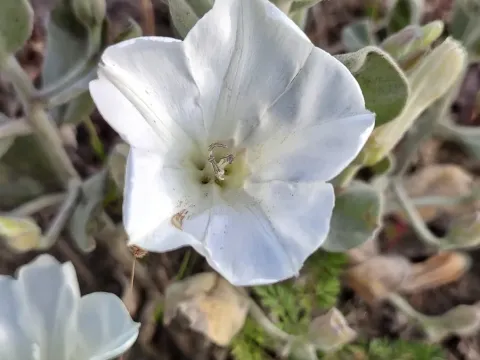
Persian bindweed
Convolvulus persicus
Persian bindweed (Convolvulus persicus) is a perennial herbaceous plant belonging to the Convolvulaceae family. It is distinctively adapted to coastal environments, specifically thriving in sandy, saline substrates where it plays a critical role in local vegetation patterns.
What the section contains
Persian bindweed
Botanically, the plant is characterized by its thick, felt-like pubescence, which covers both leaves and stems. This physical trait serves as a crucial adaptation to arid conditions, significantly reducing transpiration rates and protecting the plant from excessive solar radiation and salt spray.
The climatic requirements for this species are centered around temperate to Mediterranean zones with high sun exposure. It is a heliophilous plant, meaning it requires full sun to maintain vigorous growth and to reach its flowering phase during the appropriate season.
In terms of soil management, Convolvulus persicus requires highly permeable, sandy, or loose soils. It is intolerant of waterlogging, which can cause root rot, and therefore it is best suited for coastal areas or specific landscaping projects where excellent drainage is guaranteed.
From an agricultural and environmental perspective, this plant is primarily valued for its potential in soil conservation. By stabilizing shifting sands with its extensive root architecture, it acts as a pioneer species in the remediation of degraded coastal dunes and sandy wasteland areas.