
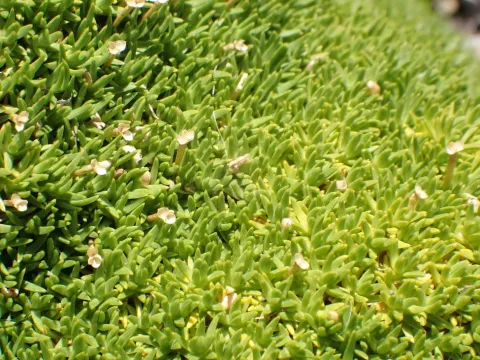
Scleranthus biflorus
Scleranthus biflorus
Scleranthus biflorus is a fascinating perennial herb belonging to the Caryophyllaceae family, renowned for its tight, moss-like mounds. Native to Australia and New Zealand, this plant thrives in open, rocky environments, creating a striking visual impact in managed landscapes.
What the section contains
Scleranthus biflorus
This species is highly heliophilic, demanding full sun exposure to maintain its characteristic compact habit. When grown in shaded areas, the plant becomes leggy and loses its distinct cushion form, which significantly reduces its ornamental value in landscaping projects.
Soil requirements for this culture are specific: it necessitates excellent drainage to prevent root rot. It is perfectly adapted to poor, sandy, or gravelly soils. In agricultural or ornamental settings, incorporating a thick layer of grit or drainage material is essential for its long-term survival.
Regarding climate, Scleranthus biflorus performs best in regions with moderate temperatures. While it has some tolerance for frost, it is not suited for high-humidity, subtropical environments, as the combination of heat and damp air can lead to rapid decay of the foliage.
Its primary use is in modern landscaping as a reliable ground cover for rock gardens, gravel pits, and xeriscapes. It mimics the aesthetic of moss without the need for constant moisture, making it a low-maintenance alternative for minimalist garden designs.
The most critical threat to the health of Scleranthus biflorus is fungal infection caused by poor air circulation and excessive moisture. Root rot is the primary cause of mortality in cultivated specimens, often triggered by waterlogged conditions.
During humid seasons, plants may develop fungal leaf spots or blight. To mitigate this risk, it is essential to ensure that the surrounding environment is kept clean of fallen organic debris that could trap moisture against the plant's delicate stems.
Slugs and snails present a significant pest risk during the spring growth phase. These mollusks feed on the dense vegetation, creating holes and patches that compromise the uniform look of the plant mound.
Invasive weed encroachment can also be considered a threat to the plant's health. Weeds can compete for root space and restrict the necessary airflow that keeps the mound dry and healthy, so regular manual weeding is recommended.
If chemical intervention becomes necessary, application of fungicides should be done with caution. Since the plant is compact and dense, spraying must ensure coverage reaches the interior of the mound, although preventative cultural practices are much more effective than cure.