
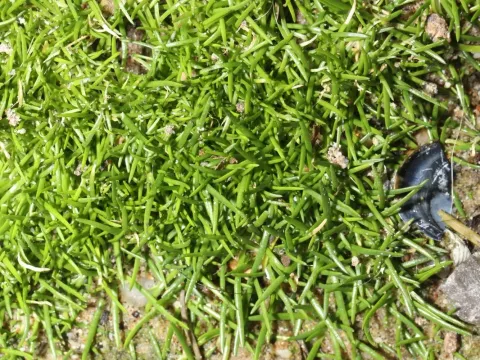
Procumbent pearlwort
Sagina procumbens
Procumbent pearlwort is a perennial herbaceous plant belonging to the Caryophyllaceae family. In agriculture, it is often classified as a persistent weed that thrives in compacted and moist soils.
What the section contains
Procumbent pearlwort
The species has a cosmopolitan distribution, originating in temperate regions of the Northern Hemisphere, and is now found worldwide in lawns, nurseries, and cultivated fields.
Botanically, it is characterized by its mat-forming habit and its ability to root at the nodes. This feature makes it highly resistant to mechanical traffic and mowing, allowing it to spread rapidly.
It prefers heavy, wet soils but exhibits wide environmental tolerance. In agricultural contexts, maintaining proper soil drainage and aeration is a fundamental technique for controlling its proliferation.
While often treated as a weed, the plant is sometimes utilized in horticulture as a decorative ground cover because it produces dense, moss-like foliage without the need for constant maintenance.
The plant is resilient against most common garden pests, but in agricultural settings, it can act as a reservoir for viruses that infect valuable vegetable crops.
Slugs and snails frequently harbor within dense pearlwort mats, making these areas potential hotspots for infestation that can later spread to agricultural production plots.
Soil-borne nematodes may also target the roots, though this rarely causes the plant to die back, serving more as a vector for secondary issues within the field ecosystem.
Management strategies require a combination of cultural practices, such as deep tilling to disrupt rooting, and the application of herbicides when mechanical removal is not feasible.
Due to its high seed production capacity, preventing the plant from flowering is critical to reducing future population density within a crop rotation system.