
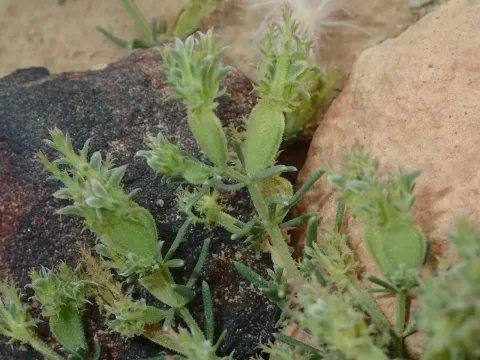
Pteranthus
Pteranthus
Pteranthus dichotomus is an herbaceous annual plant belonging to the Caryophyllaceae family. It is native to the arid regions of North Africa, the Middle East, and parts of Southern Europe, where it has evolved to thrive in harsh environments.
What the section contains

Pteranthus
As a potential agricultural crop, Pteranthus is suitable for arid-zone farming and land reclamation projects. Its ability to complete its life cycle during short windows of moisture makes it an interesting subject for desert agriculture research.
Sowing typically coincides with the arrival of seasonal rains in its native habitat. Seeds require a brief period of moisture to germinate successfully, after which the plant quickly develops its vegetative structure to store energy for flowering.
The plant exhibits a unique dichotomous branching pattern, which helps it maximize exposure to sunlight while maintaining a compact, wind-resistant structure. Its leaves are narrow and linear, specialized to reduce water loss through transpiration.
Deep-reaching root systems allow Pteranthus to extract water from lower soil profiles. This biological feature is essential for its survival in nutrient-poor and moisture-depleted desert sands where traditional crops fail to establish.
Pteranthus demands high solar irradiance and exposure to direct sunlight throughout the entire growing season. Shading significantly decreases biomass production and inhibits the development of reproductive parts, such as seeds.
The ideal soil composition for this crop is loose, well-draining sand or sandy loam. These soil types prevent waterlogging, which is detrimental to the plant’s roots and can lead to rapid decay in humid conditions.
The climate must be characterized by mild winters and hot, dry springs. Excessive precipitation or high humidity is detrimental, as it encourages fungal pathogens and disrupts the plant’s natural physiological cycles.
Soil pH should ideally be neutral to slightly alkaline. Pteranthus is well-adapted to the calcareous soils commonly found in arid zones, and it does not require significant fertilization to achieve adequate growth.
Management practices should focus on maintaining open, weed-free rows to ensure optimal light penetration. Since the crop is highly sensitive to root disturbance, cultivation should be kept to a minimum after plant emergence.
Fungal diseases, particularly those affecting the roots and stems, are the primary threat in environments with inadequate ventilation or sporadic rainfall. Early detection and improvement of drainage are the best control strategies.
Pests such as aphids and spider mites can colonize the foliage during favorable climatic conditions. In desert environments, migratory locusts pose a severe, often unpredictable threat to plantations of Pteranthus.
Viral infections transmitted by sap-sucking insects can severely stunt growth and reduce seed yield. Maintaining healthy plant populations and preventing insect vectors is crucial for minimizing viral outbreaks.
Weed competition during the seedling stage is critical, as Pteranthus grows slowly initially. Manual or light mechanical weeding is recommended to ensure the young plants have access to nutrients and water.
Soil degradation, including wind erosion, can lead to the exposure of root systems. Using protective mulching or intercropping techniques can enhance the stability and overall health of the Pteranthus crop.