
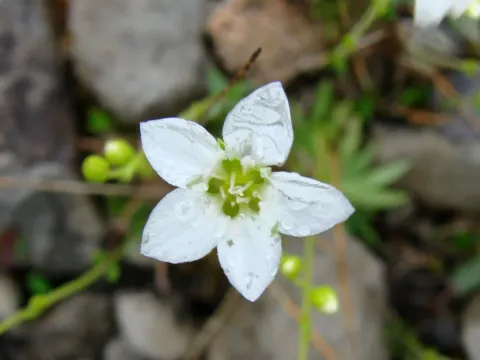
Arenaria redowskii
Arenaria redowskii
Arenaria redowskii is a resilient perennial herb belonging to the Caryophyllaceae family, typically propagated by seeds sown during the early spring months.
What the section contains
Arenaria redowskii
The seeds are small and should be scattered over a well-drained, sandy surface without deep burial to ensure optimal light-dependent germination.
For container or seedling production, a light potting mix rich in mineral components is recommended to prevent early-stage damping-off diseases.
Outdoor sowing requires a prepared bed free of competing weeds, as the young seedlings are slow to establish and sensitive to early competition.
Once established, the plants form dense mats that can be further propagated by division, ensuring the roots are well-protected during the process.
This species thrives in well-drained, nutrient-poor soils, reflecting its natural adaptation to rocky outcrops and sandy mountainous landscapes.
Full sun exposure is an absolute necessity for Arenaria redowskii to maintain its compact growth form and prevent etiolation of the stems.
Excessive soil moisture is detrimental, making effective drainage the most critical factor in successful cultivation, especially during winter months.
The plant is highly drought-tolerant once mature, requiring little supplementary irrigation, provided it is grown in a suitable site with good airflow.
Low-fertility soils are preferred to maintain the characteristic habit of the species, as over-fertilization often leads to sparse and unstable growth.
Root rot remains the most significant threat to this crop, primarily triggered by poor soil structure or prolonged waterlogging in non-porous soils.
In humid or stagnant air conditions, fungal infections such as powdery mildew can compromise the foliage, necessitating better spacing and ventilation.
Spider mites can become a challenge during periods of extreme heat and drought, feeding on the leaves and causing chlorosis or stunting of the growth.
Root-knot nematodes can occasionally affect the root system, causing general decline; proper crop rotation or soil treatment is advisable in infested areas.
Proactive management involves removing debris and affected plant material promptly to limit the spread of pathogens throughout the entire plantation.