
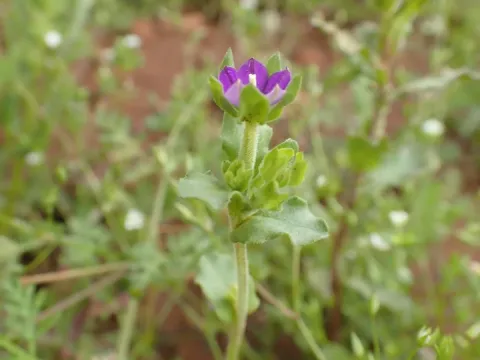
Venus's looking-glass
Legousia hybrida
Legousia hybrida, commonly known as Venus's looking-glass, is an annual herbaceous plant belonging to the Campanulaceae family. Within agricultural settings, it is primarily identified as a weed, although its botanical properties are of scientific interest.
What the section contains
Venus's looking-glass
The plant thrives in open, sunny habitats with light, well-drained, and often calcareous soils. It is frequently observed within winter cereal fields, where it manages to complete its life cycle alongside the main crop.
Its natural range extends across Europe, the Mediterranean region, and parts of Western Asia. The species is highly adaptable to temperate climates, showing significant resilience to fluctuating environmental conditions during the spring season.
A distinctive botanical feature is its tendency toward cleistogamy, where flowers remain closed and self-pollinate. This reproductive strategy ensures a high success rate for seed production, making the plant a persistent presence in arable lands.
While not a commercially cultivated crop, understanding its biology is essential for farmers and agronomists to manage its population dynamics effectively within diverse cropping systems.
Legousia hybrida is susceptible to various fungal pathogens typical of the Bellflower family, including powdery mildew and rusts, which can impede its growth and development in dense agricultural environments.
Insect pests, such as aphids and thrips, frequently colonize the plants. These pests feed on the sap, causing foliage damage and potentially reducing the overall vigor of the weed population.
Integrated weed management remains the most effective approach to control this species. This includes a combination of tillage practices, such as harrowing, and the use of targeted herbicides to manage population density.
Crop rotation serves as a fundamental strategy to disrupt the life cycle of Legousia hybrida. By altering the timing of planting and cultivation, producers can significantly diminish the seed bank in the soil.
Monitoring the infestation levels in fields is recommended to determine the economic threshold for intervention, ensuring that control measures are both environmentally and economically sustainable.