
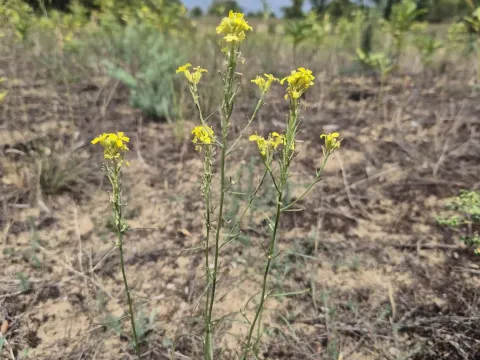
Erysimum canum
Erysimum canum
Erysimum canum, a member of the Brassicaceae family, is a valuable medicinal plant known for its pharmaceutical potential. Sowing is typically performed in early spring once soil temperatures reach 8–10 degrees Celsius to ensure reliable germination.
What the section contains
Erysimum canum
The seeds should be planted at a shallow depth of 1–2 centimeters, as they are minute and sensitive to burial depth. A well-prepared seedbed with a fine structure is essential for uniform emergence across the field.
Row spacing is generally set between 30 and 45 centimeters. This allows for mechanical weed control during the early development stage, which is crucial since the plant grows slowly until it establishes a robust rosette.
Thinning the seedlings is a necessary step to maintain an optimal plant density of approximately 15–20 centimeters between plants in a row. Proper spacing ensures adequate airflow and prevents competition for sunlight.
Strategic site selection is vital; the chosen land should be free from perennial weeds, as the young Erysimum canum plants are initially poor competitors against aggressive weed species.
This crop thrives in full sun and is highly photophilic. Adequate light intensity is directly correlated with the plant's ability to synthesize cardiac glycosides, the primary compounds of industrial interest.
Erysimum canum adapts to various soil types but demonstrates superior yields in loose, fertile loamy or chernozem soils with a neutral pH level. Well-draining soil is a requirement to prevent root-related issues.
The plant possesses notable drought tolerance but is sensitive to waterlogged conditions. Fields with standing water after heavy rains are unsuitable as they quickly lead to root rot and severe yield losses.
An optimal growth temperature ranges from 18 to 25 degrees Celsius. While it can withstand moderate cool spells, sustained high heat or extreme cold can influence the timing of the flowering phase.
Fertilization with phosphorus and potassium is highly beneficial for the development of bioactive compounds. Nitrogen applications should be managed carefully to avoid excessive vegetative growth at the expense of medicinal quality.
The economic value of Erysimum canum lies in its aerial parts, harvested specifically for the production of cardiostimulating drugs. The concentration of active substances is the primary metric of harvest quality.
With correct agronomic practices, the yield of dry mass can reach between 1.5 and 2.5 tonnes per hectare. Variability in yield is often linked to the timing of harvest and the precision of the drying process.
Pharmacological efficiency is peaking during the flowering stage. Therefore, the harvesting schedule must be tightly aligned with the floral phenology of the crop to maximize the output of cardiac glycosides.
Post-harvest handling involves rapid processing in drying facilities. Controlling the moisture content of the dried product is essential for stability and long-term storage in pharmaceutical warehouses.
Implementing integrated crop management programs ensures consistent production quality, meeting the standards required by the medical industry for raw botanical materials.
The primary pest affecting Erysimum canum is the flea beetle, which can devastate entire fields of young seedlings within a short period. Early monitoring and protective measures are mandatory.
Fungal diseases like powdery mildew are common in high-humidity climates or overcrowded stands. Maintaining proper spacing and field hygiene helps in reducing the incidence of these pathogens.
Root-knot nematodes can potentially undermine plant health on heavily infected sites. Crop rotation, avoiding continuous planting of Brassicaceae, is the most effective management strategy against these soil-borne pests.
Aphid infestations during the budding phase can deform the flowering structures and reduce both biomass yield and seed quality. Biological or selective chemical controls are applied based on threshold observations.
Overall, regular scouting and adherence to crop rotation principles are the best tools for mitigating biological threats without excessive reliance on synthetic chemicals.
The harvest must be conducted exactly during the mass flowering period. This ensures that the concentration of active medicinal compounds is at its maximum, fulfilling the raw material requirements.
Mechanical mowing is the standard harvest method, with the cutter bar set 5–10 centimeters above the ground to collect the most productive biomass while excluding soil particles and contaminants.
Immediately after harvest, the raw material must be transported to a drying facility. Delaying this process leads to fermentation, which causes the chemical degradation of the essential medicinal glycosides.
The drying process involves temperatures between 40 and 50 degrees Celsius to ensure the preservation of heat-sensitive compounds. Uniform drying is necessary for long-term storage quality.
Storage should occur in climate-controlled environments, protecting the dried herb from light, moisture, and pests until it is ready for pharmaceutical processing and extraction.