
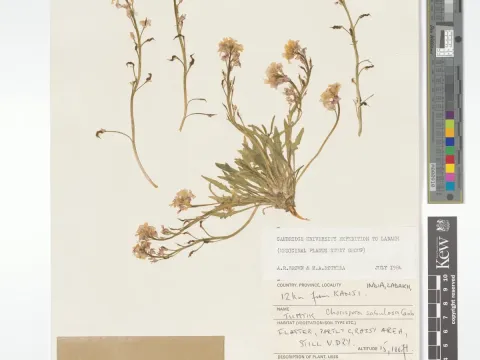
Chorispora sabulosa
Chorispora sabulosa
Chorispora sabulosa is a perennial herbaceous plant belonging to the Brassicaceae family. It is distinctively adapted to xeric environments, primarily thriving in sandy, loose, and poorly developed soils where competition from other vegetation is minimal.
What the section contains
Chorispora sabulosa
Botanically, the species features a deep-reaching taproot system, which serves as a critical evolutionary adaptation for accessing moisture in subsurface layers, allowing it to survive in arid, sandy terrains.
Regarding climatic preferences, this species is highly photophilous, requiring full exposure to sunlight for optimal development. It shows remarkable resilience to the extreme temperature fluctuations typical of its native continental climates.
Soil requirements are centered on excellent drainage. The plant cannot tolerate compacted, heavy clay soils or prolonged waterlogging, as these conditions lead to root rot and failure in gas exchange.
The native range encompasses semi-arid and arid regions of Central Asia, where the species plays a role in stabilizing sandy substrates and contributing to the local biodiversity of desert ecosystems.
As a non-commercial, wild-growing species, Chorispora sabulosa does not face the same pest pressures as cultivated cruciferous crops. However, it shares general susceptibility to common Brassicaceae pests.
Crucifer flea beetles are among the primary potential threats, particularly affecting seedlings and young foliage during the early spring growth phase, which can stunt the plant's development.
In terms of pathogens, excessive moisture or lack of soil ventilation provides a favorable environment for fungal infections, such as damping-off or various root rot complexes, especially in disturbed or irrigated soil patches.
Competition from invasive plant species poses a significant threat to established populations, as Chorispora sabulosa has a slow initial growth rate and can be easily outcompeted for light and space.
Integrated management of the plant's environment—focusing on maintaining proper soil aeration and minimizing weed interference—is crucial for its survival and proliferation in introduced or managed areas.