
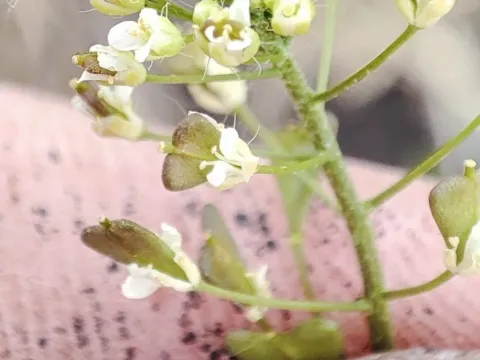
Capsella orientalis
Capsella orientalis
Capsella orientalis is an annual herbaceous plant known for its high ecological adaptability. Seed germination typically occurs in early spring when soil temperatures reach 3–5°C, although autumn germination is also possible under favorable moisture conditions.
What the section contains
Capsella orientalis
In agricultural settings, seeds of this species can remain viable in the soil for several years. Sowing depth should be kept shallow, as the seeds are highly sensitive to darkness and require adequate light exposure to trigger effective germination.
The optimal sowing density depends on the intended use of the crop, whether for medicinal production or biological research. It is crucial to maintain appropriate row spacing to allow the leaf rosette to develop freely during the initial stages of the growing season.
The species exhibits a strong propensity for self-seeding, which necessitates strict monitoring of field operations. If grown as an accompanying crop, its competitive nature against primary agricultural species must be carefully managed to prevent yield suppression.
Seedbed preparation should include thorough loosening of the topsoil to create a fine-grained structure. Rolling the soil after sowing improves seed-to-soil contact, which significantly enhances the percentage of germination and overall uniformity of the stand.
As a member of the Brassicaceae family, the plant is relatively undemanding regarding its growing environment. It successfully adapts to various soil types, including loams, sandy soils, and even mildly saline soils with moderate moisture levels.
Optimal climatic conditions for development include moderate air temperatures ranging from 15–22°C. Despite this, the plant possesses good frost resistance and can withstand late spring frosts without significant damage to its vegetative organs.
The crop is light-loving and reacts negatively to shading by other taller species. Under insufficient light, growth rates slow down significantly, and the development of generative organs is either delayed or results in poorly formed seed pods.
Moisture requirements are moderate, with the plant efficiently utilizing spring soil moisture. During prolonged drought, Capsella orientalis tends to transition rapidly to the flowering phase, which can lead to an early termination of its developmental cycle.
For successful vegetation, soils with a neutral or slightly alkaline reaction are preferred. The plant responds well to the presence of available nitrogen and phosphorus in the soil, resulting in more vigorous biomass accumulation and a higher yield of seed pods.
The biological productivity of the plant is evidenced by the production of a large quantity of seeds, ensuring the species' persistence in agroecosystems. Green biomass yield depends directly on soil quality and the light intensity provided at the site.
When cultivated for specialized purposes, biomass metrics vary according to the agricultural background and soil fertility. Maximum yields are achieved under consistent moisture and the absence of competition from neighboring plants.
Each mature plant is capable of producing several thousand seeds, making the species highly effective in terms of reproduction. Harvesting requires precise timing to coincide with maturity stages to prevent spontaneous seed shedding in the field.
Moderate application of fertilizers can increase the dry matter output. However, excessive nitrogen application may cause stem lodging and reduce the quality of the raw material intended for pharmaceutical or industrial applications.
Economic viability is determined by the rational balance of planting density and maintenance practices. Adhering to optimal harvesting schedules is essential to minimize losses and ensure the highest quality of the harvested product.
This species is susceptible to diseases common to the Brassicaceae family, such as clubroot or powdery mildew. These pathogens are most likely to develop in conditions of excessive humidity and when crop rotation protocols are neglected.
Among pests, cruciferous flea beetles pose the greatest danger, often damaging cotyledon leaves during the early development stage. Both agrotechnical methods and authorized insecticides are used to mitigate this threat effectively.
Aphids can colonize flower stalks, extracting sap and suppressing fruit development. Regular monitoring of crop health allows for the early detection of infestation sites and prevents the mass spread of insects throughout the entire field.
Soil-dwelling pests like wireworms can cause damage if population densities are high. Regular inter-row cultivation and the maintenance of an optimal irrigation regime help reduce the negative impact of subterranean phytophages.
Disease prevention includes the use of high-quality, certified seed material and the maintenance of spatial isolation from other cruciferous crops. Healthy and vigorous plants exhibit significantly higher resistance to the complex of diseases and pests.
Harvesting should be conducted during the mass maturation period, when the lower seed pods begin to acquire a characteristic yellowish-brown color. It is vital to avoid letting the stems dry completely to prevent seed shattering during mechanical handling.
For manual harvesting, the use of sickles or shears is recommended, cutting the plants at the base. In mechanized systems, equipment equipped with specialized small-seed collection systems is optimal to prevent losses during the threshing process.
After harvesting, the material must be dried quickly in well-ventilated areas or under a canopy. Even drying is essential to prevent mold growth and ensure the preservation of the plant's active biological components.
Threshing is carried out once the plants have reached full dryness. Cleaning seeds from impurities and plant residues is achieved through multi-stage sorting systems to ensure the high quality of the final commercial lot.
Storage of the harvested yield should take place in dry, protected facilities, shielded from rodents and pests. Maintaining a correct air humidity level (not exceeding 12–14%) is the key condition for the long-term preservation of raw material properties.