
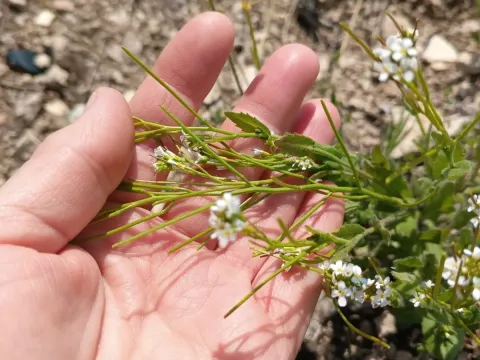
Arabis auriculata
Arabis auriculata
Arabis auriculata, commonly known as eared rockcress, belongs to the Brassicaceae family. While primarily found in the wild, it serves as an interesting subject for specialized agricultural cultivation, particularly in soil stabilization and as a beneficial forage plant.
What the section contains
Arabis auriculata
The sowing process typically begins in early spring. The seeds are very small and should be sown on the surface of the soil or covered with a very thin layer of substrate. Optimal germination occurs at moderate temperatures between 10 and 15 degrees Celsius.
For large-scale planting, it is recommended to drill the seeds in rows spaced about 25 centimeters apart. Mixing the seeds with fine sand before scattering helps to achieve an even distribution across the field, preventing uneven density.
Autumn sowing is also a viable option in regions with mild winters. During this time, the seeds undergo natural cold stratification, which significantly improves the synchronization of seedling emergence when spring arrives.
It is essential to maintain consistent moisture after sowing. Using specialized equipment to press the soil lightly after planting ensures that the seeds have sufficient contact with the earth, facilitating faster and more reliable germination.
Eared rockcress thrives in well-drained, slightly alkaline, or neutral soils. It is highly intolerant of waterlogged conditions, which can lead to rapid root decay, thus requiring light, porous soil structures to flourish.
This crop requires significant sun exposure. Full sunlight is necessary for the development of sturdy stems and healthy, compact foliage. Shaded environments negatively impact the plant's structural integrity and overall vigor.
Regarding climate, Arabis auriculata is well-adapted to temperate regions. It can withstand intermittent spring frost without significant damage, although it performs best when temperature fluctuations are minimized during the early growth stages.
Fertilization should be handled with caution. The plant does not require high levels of nitrogen, as excessive application leads to weak, elongated growth. Potassium and phosphorus fertilizers are preferred to support root development and flowering.
Maintenance involves frequent weeding during the initial development phase. Since the plant starts as a low-growing rosette, it can easily be outcompeted by aggressive weeds if the area is not properly cleared.
Common diseases affecting this plant include downy mildew and various types of root rot. These are often triggered by excessive humidity levels and poor soil aeration, highlighting the importance of proper spacing and drainage.
Pests such as crucifer flea beetles are the most significant threat to young plants. Early inspection and the use of physical barriers like fine mesh can provide effective protection during the most vulnerable growth periods.
Caterpillars of cabbage white butterflies may also target the leaves. Integrated pest management, focusing on biological controls or targeted application of insecticides, is recommended to keep damage below economic thresholds.
Implementing a strict crop rotation strategy is vital. Avoiding the cultivation of Arabis auriculata on plots previously used for other Brassicaceae plants helps significantly reduce the incidence of soil-borne pathogens.
Sanitation practices after the harvest, including the removal and destruction of crop debris, are essential for preventing the carry-over of eggs and spores that could jeopardize the following year's crop.