
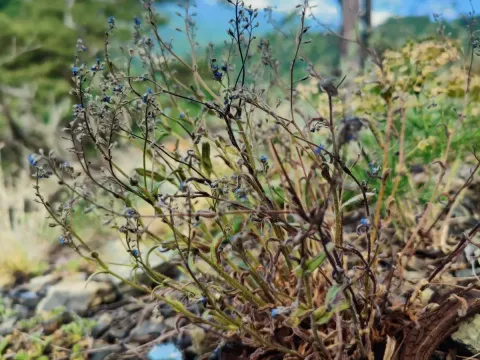
Narrow-leaved forget-me-not
Myosotis stenophylla
The narrow-leaved forget-me-not (Myosotis stenophylla) is a herbaceous plant belonging to the Boraginaceae family. It is distinct from common forget-me-nots due to its slender foliage and its specific adaptation to high-altitude mountain environments.
What the section contains
Narrow-leaved forget-me-not
Originating from the mountain ranges of Central Asia, this species has evolved to thrive in rocky, well-drained soils where competition from larger plants is limited and water drainage is rapid.
Cultivation of this species requires a soil medium that mimics its natural habitat: it needs a neutral or slightly alkaline pH with excellent porosity, often enhanced with gravel or grit to prevent moisture stagnation.
The plant is highly photophilic and requires full sun exposure to maintain its compact growth habit and produce vibrant blooms during its relatively short flowering period.
In terms of usage, it is highly valued by rock garden enthusiasts and landscape designers for its ability to form dense, low-growing patches in difficult, stony locations where other flowers might struggle.
Sowing in open ground is typically recommended for late autumn, allowing the seeds to undergo natural winter stratification, which significantly improves germination rates in early spring.
For those opting for spring sowing, artificial stratification in a cold environment (2-5 degrees Celsius) for several weeks is a necessary step to overcome seed dormancy.
Seeds should be surface-sown or covered with only the lightest dusting of soil, as they require light to stimulate the germination process correctly.
Watering the seedbed should be done carefully using a fine mist to avoid washing away the tiny seeds or burying them too deep within the soil profile.
Seedlings should be thinned once they reach the two-leaf stage, ensuring that each plant has enough space to develop its root system without crowding.
Fungal pathogens are the most common issue for Myosotis stenophylla, particularly if the plant is grown in areas with poor air circulation or consistently high humidity levels.
Powdery mildew can quickly establish itself on the foliage, appearing as a white dusty coating that weakens the plant and diminishes its aesthetic value significantly.
Root rot is a critical threat that usually indicates a failure in soil drainage; the roots become necrotic if they remain in saturated soil for extended periods.
Aphids are the primary insect pests affecting the species, targeting the tender terminal shoots and flower buds, which can lead to stunted growth and deformed flowers.
Integrated pest management, including regular inspection and the use of targeted biological controls, is highly recommended to keep the plants healthy without relying solely on chemical intervention.