
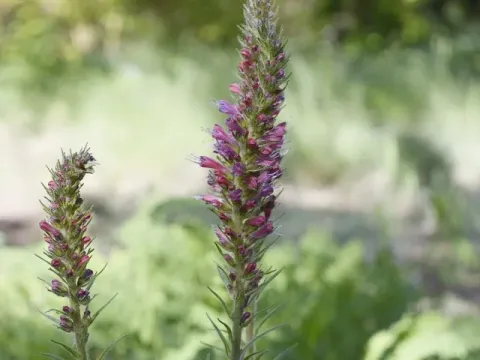
Red viper's bugloss
Echium rubrum
Red viper's bugloss (Echium rubrum) is a biennial or short-lived perennial belonging to the Boraginaceae family, prized primarily for its high nectar output.
What the section contains
Red viper's bugloss
Sowing typically takes place in early spring once the soil temperature is stable, or in late autumn to allow the seeds to undergo natural stratification for better germination.
The seeds should be sown at a shallow depth of 1-2 centimeters, ensuring they remain in contact with moist soil while having enough light to germinate effectively.
Row spacing is usually maintained at 40-50 centimeters to allow for adequate airflow and weed control during the initial stages of plant development.
Proper field preparation is critical, as this plant requires a clean seedbed free of aggressive perennial weeds that could outcompete the young seedlings.
This species thrives in sunny, open environments and is highly intolerant of shade, which directly suppresses nectar production and plant vigor.
It prefers well-drained, calcareous soils but is remarkably versatile, being able to adapt to poor, rocky, or sandy substrates where other crops would fail.
Exceptional drought tolerance is one of the key characteristics of Echium rubrum, thanks to its deep taproot system that explores lower soil layers.
The plant is hardy and resistant to temperature fluctuations, making it suitable for a wide range of temperate climates throughout Europe and beyond.
Avoid planting in heavy clay or waterlogged soils, as excessive moisture can quickly lead to root rot and significant stand loss during the growing season.
Echium rubrum is renowned among beekeepers as a superior honey plant, capable of producing high volumes of nectar even in hot and dry weather conditions.
Under optimal environmental conditions, honey yields from a hectare of this crop can range between 150 and 300 kilograms per season.
The extended flowering period, which often lasts for several weeks, provides a reliable and steady source of high-quality pollen and nectar for honeybee colonies.
The honey produced from this plant is highly regarded for its delicate taste and slow crystallization, making it a valuable product in the apiculture industry.
In addition to its role as a honey source, the plant creates significant biomass that can be integrated into ecological soil improvement programs.
The plant possesses a natural defensive mechanism in the form of stiff hairs on the foliage, which deter many generalist insect pests from feeding.
Fungal diseases like powdery mildew may occur in areas with poor ventilation or high humidity levels, requiring careful management of plant density.
While generally robust, young plants can be susceptible to root-feeding larvae if the field has not been properly cleared of weeds prior to sowing.
Overall, pest pressure is minimal, and the crop typically does not require chemical intervention if grown in appropriate environmental conditions.
- Implement crop rotation to avoid soil-borne pathogens.
- Ensure adequate plant spacing for light and airflow.
- Monitor for aphid outbreaks during late spring.
Harvesting for seed production should occur when the flower stalks have turned brown and the seeds exhibit a dark, mature appearance.
Because seeds ripen gradually within the flower head, timing the harvest requires careful observation to prevent excessive shattering in the field.
Direct combining is possible, but a two-stage process — cutting and windrowing — is often preferred to allow for even drying before threshing.
Post-harvest processing involves cleaning the seeds of debris and reducing moisture content to below 12% to ensure long-term viability and storage stability.
Store the harvested seed in a cool, dry, and well-ventilated area to maintain high germination rates for future planting cycles.