
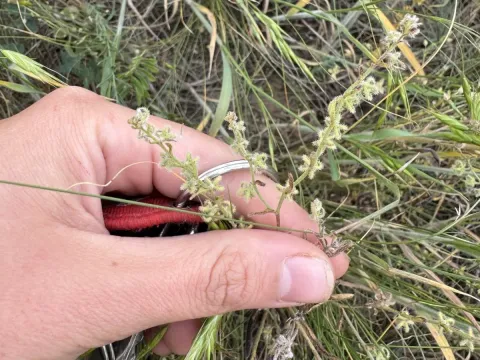
Rochelia
Rochelia
Rochelia is not a cultivated agricultural crop, but rather a wild plant often identified as a weed in agricultural landscapes. Its life cycle follows an ephemeral pattern, thriving primarily during the cool spring months when moisture is available.
What the section contains

Rochelia
Seed germination is triggered by temperature fluctuations and the availability of moisture after winter. In cultivated fields, its early emergence often overlaps with the initial growth stages of winter cereals, creating immediate competition.
The plant completes its entire life cycle—from seedling to seed dispersal—within a very short timeframe. This rapid development allows it to exploit resources before late-spring heat limits the growth of less resilient species.
Seeds are highly persistent and can remain dormant in the soil seed bank for several seasons. Dispersal is facilitated by environmental factors such as wind and water, as well as human activity involving farm equipment.
Management strategies focus on early-season cultivation and the use of targeted herbicides to prevent the plant from reaching the seed-set stage. Once seeds are released into the soil, long-term control becomes significantly more difficult.
Belonging to the Boraginaceae family, Rochelia is well-adapted to open, semi-arid habitats. It prefers well-drained soils, often thriving in sandy, rocky, or loamy conditions that are common in steppes and dry meadows.
The plant is highly drought-tolerant, an evolutionary trait that enables it to occupy ecological niches where water scarcity is the primary limiting factor for other vegetation. It performs poorly in waterlogged or heavy clay environments.
Rochelia thrives in full sun exposure. While it is not shade-tolerant, its early growth habit allows it to maximize light capture before the canopy of perennial grasses or taller crops fully develops in the spring.
The species is indifferent to low soil nutrient levels, frequently colonizing degraded or eroded areas where nutrient turnover is slow. Its resilience in such conditions makes it a pioneer species on disturbed land.
Geographically, its distribution spans across Eurasian steppe regions, where the climate supports a pronounced dry season. It is particularly prevalent in areas with high light intensity and low annual precipitation.
Like many members of the Boraginaceae family, Rochelia can be affected by powdery mildew and various fungal leaf spot pathogens. While these diseases may weaken individual plants, they rarely eradicate entire populations.
Several insect pests, including various beetles and aphids, feed on the foliage of Rochelia. These pests act as a minor biological control factor, though they are usually insufficient to prevent the plant from reproducing.
The primary concern for farmers is the plant's role as a reservoir for viruses. These pathogens can be vectored by insects from Rochelia to high-value crops, leading to significant yield losses if not managed properly.
Competition for nitrogen and moisture during the spring is the main agronomic challenge. Even a moderate density of this weed can lead to reduced tillering and nutrient stress in cereal crops if left untreated.
Due to its hardiness, physical suppression through mechanical means is often only partially successful. A multi-year strategy involving integrated weed management (IWM) is necessary to keep its population below economic thresholds.