
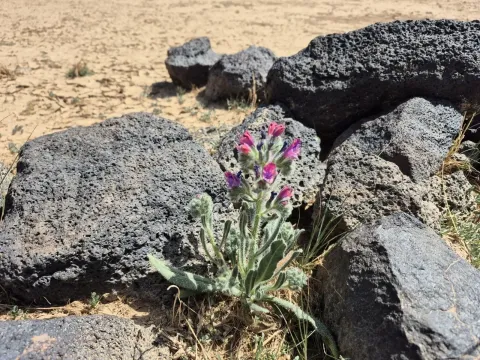
Rauwolf's viper's bugloss
Echium rauwolfii
Rauwolf's viper's bugloss, a member of the Boraginaceae family, is a resilient plant suitable for cultivation in semi-arid and marginal agricultural zones. Sowing should take place in early spring once soil temperatures reach a stable 8–10 degrees Celsius.
What the section contains
Rauwolf's viper's bugloss
Seeds should be sown at a shallow depth of 1–2 centimeters, ensuring they are placed in firm soil to facilitate germination. Proper seedbed preparation is vital to ensure an even distribution and uniform plant establishment.
The seeding rate typically ranges from 5 to 8 kilograms per hectare, depending on the sowing method and soil fertility. Mechanical drilling is preferred to maintain consistent depth and optimal spacing between rows.
As the plant develops a taproot quickly, early spring planting allows it to establish a strong root system before the onset of summer drought, ensuring better survival and growth.
Maintaining clear rows during the early stages of development is crucial, as the young rosettes of the plant can be easily outcompeted by aggressive weed species in the field.
This species thrives in sunny, well-lit environments and is sensitive to shading, which significantly reduces biomass and floral nectar production. It prefers alkaline or neutral soils with excellent drainage.
The plant is highly drought-tolerant, utilizing a deep taproot to extract moisture from deep soil layers, making it an excellent candidate for regions with limited rainfall.
Waterlogged or poorly drained soils are detrimental to the plant, as they promote root rot and weaken the overall plant vitality, leading to reduced yield in nectar and seed.
It performs exceptionally well in poor or rocky soils where traditional crops often fail, allowing farmers to utilize marginal land for productive agricultural purposes.
While the plant requires little fertilization, a light application of phosphorus and potassium during the rosette phase can boost overall health and enhance flower production during the blooming season.
The primary economic use of Rauwolf's viper's bugloss is in the beekeeping industry. It is highly valued as a top-tier honey plant that provides a consistent source of high-quality nectar.
Honey produced from this species is known for its light color, delicate flavor profile, and slow crystallization, making it a premium product in the global honey market.
Beyond nectar, the crop produces significant organic matter, which can be integrated into the soil as green manure to improve soil structure and organic content after the growing season.
Seed production is an additional revenue stream, as the seeds contain valuable oils that have potential applications in the cosmetic and technical manufacturing industries.
Through careful management, farmers can achieve sustainable yields of both honey and seeds, creating a dual-purpose agricultural model that benefits local ecosystem biodiversity.
The plant is generally robust and resistant to most agricultural diseases. However, in exceptionally humid or poorly ventilated conditions, powdery mildew can emerge on the leaves.
Specific weevil species are the primary pests of this crop, focusing their damage on flower buds, which can lead to a decrease in nectar availability and total seed yield.
Integrated Pest Management (IPM) is essential. Because the field serves as a vital forage area for bees, the use of chemical insecticides should be completely avoided during the flowering stage.
Maintaining proper field sanitation and removing surrounding wild hosts of the same family can significantly reduce the risk of pest infestation within the cultivated area.
Ensuring optimal plant density promotes air circulation throughout the crop, which is one of the most effective ways to naturally suppress the development of fungal diseases.
Harvesting seeds requires careful timing; it should occur when the seed pods begin to turn brown and harden, signaling physiological maturity. Early harvesting is crucial to prevent yield loss from pod shattering.
Modern grain combines can be used for harvesting, provided they are set to low-drum speeds to prevent mechanical damage to the sensitive and brittle seeds.
Once harvested, seeds must be cleaned of debris and dried to a moisture content of 10–12 percent to ensure safe storage and maintain high germination rates for the following season.
If the crop is utilized solely for honey production, harvesting the plant material is unnecessary; instead, the plants should be left until the end of the blooming season to maximize the harvest period.
After the seeds have been collected, the remaining biomass can be shredded and incorporated back into the soil, providing a natural nutrient return to the field for subsequent rotational crops.