
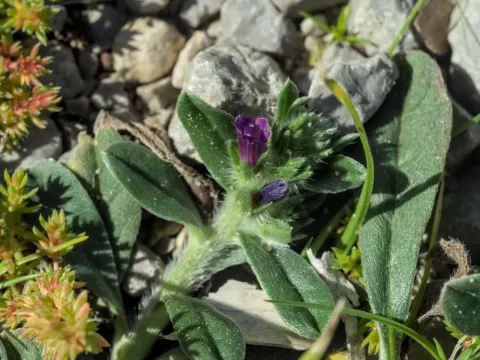
Sand Viper's Bugloss
Echium arenarium
Echium arenarium is typically a biennial crop, meaning the production cycle spans over two years. Sowing is usually performed in early spring as soon as soil temperatures allow, ensuring the seeds take advantage of residual winter moisture for consistent germination.
What the section contains
Sand Viper's Bugloss
Alternatively, late autumn sowing is an effective strategy that subjects the seeds to natural stratification. This process breaks seed dormancy and often results in more vigorous spring growth, which is particularly beneficial when establishing the crop in sandy soils.
Because the seeds are relatively small, they should be sown shallowly, ideally at a depth of 1 to 2 centimeters. Using precision seeders helps ensure even distribution across the field, preventing overcrowding that could hinder the development of the primary vegetative rosette.
The recommended seeding rate varies based on the purpose of the crop, but usually ranges between 4 and 6 kilograms per hectare for uniform stands. Properly calibrating seeding equipment is essential to maintain optimal plant density for both honey production and seed harvest.
After seeding, rolling the soil surface is a crucial final step. This action improves soil-to-seed contact, facilitating faster water uptake, and reduces surface moisture loss—a common challenge when working with dry, sandy terrains where the plant thrives best.
Sand Viper's Bugloss is renowned for its remarkable hardiness and ability to thrive in extremely poor, sandy environments where other crops would fail. Its deep taproot system makes it exceptionally drought-resistant, allowing it to access sub-surface water reserves.
Full sun is a strict requirement for the best performance of this species. Partial shade or cloudy, humid conditions can significantly impair nectar secretion, making sunny, open locations essential for farmers focusing on the plant's value as a high-yield honey source.
The plant performs best in neutral to slightly alkaline soils that offer excellent drainage. It is highly sensitive to waterlogging; therefore, farmers must avoid areas with high water tables or heavy, clay-rich soils that tend to retain moisture for too long.
Temperature tolerance is a hallmark of this species, as it withstands intense summer heat without wilting and remains cold-hardy during the winter months. This physiological robustness makes it a low-maintenance choice for diverse climates with harsh environmental fluctuations.
Agrotechnical care during the first year is primarily focused on weed control. Since the crop grows slowly during its initial vegetative phase, it is vulnerable to competition. Keeping the field clear of aggressive weeds is vital for ensuring high plant density in the second year.
The primary economic output of Sand Viper's Bugloss is its exceptional honey production potential. Under optimal environmental conditions, it can yield significant amounts of high-quality, light-colored honey that is prized by beekeepers for its slow crystallization rate.
Beyond its use as a honey plant, it serves as a valuable tool for soil stabilization. Its extensive root system helps bind loose particles in sandy regions, effectively mitigating wind erosion and promoting the accumulation of organic matter in otherwise depleted soils.
Seed production yields are highly dependent on the presence of local pollinators during the flowering period. Maintaining a healthy environment for bees and other beneficial insects is essential to maximize the reproductive success of the plant and ensure future crop rotation.
While not a primary forage crop, the plant's biomass can be incorporated into green manure programs. After harvesting, the vegetative parts can be tilled back into the soil, providing a source of organic nutrients that improves the overall fertility of the field.
Market demand for the honey and seeds of this species is consistent, driven by its reputation as a specialty product. Farmers can diversify their income streams by managing these stands as dual-purpose areas for apiculture and seed commercialization.
Echium arenarium possesses strong natural defenses, making it resistant to many common pests and diseases found in agricultural settings. The presence of stiff, trichome-like hairs on its leaves and stems acts as a natural deterrent against many herbivorous insects.
Root rot represents the most significant threat to the crop, particularly when soil drainage is insufficient. Excessive moisture around the root zone creates an environment that facilitates fungal growth, which can lead to localized crop failure in low-lying parts of the field.
Pest issues are rarely severe enough to warrant chemical intervention. Most potential threats are managed through healthy rotation schedules and by maintaining proper spacing between plants, which reduces humidity levels and prevents the development of localized pathogen hotspots.
Preventative management is key, as the use of synthetic pesticides is generally discouraged to protect the bees that frequent the blooms. Adhering to sustainable farming practices helps maintain the ecological balance and preserves the quality of the harvested bee products.
Monitoring the field for excessive weed pressure is necessary, as certain species may harbor pests that could eventually migrate to the crop. Keeping the fields well-managed and preventing overcrowding remains the most effective strategy for ensuring long-term crop health.
Harvesting for seeds is conducted in the second year of the growth cycle when the seed pods have turned brown. Timing is critical, as pods can dehisce and drop seeds with minimal physical disturbance or strong winds, leading to significant yield losses if delayed.
Direct combining is the preferred method for large-scale production, provided the plants have reached uniform maturity. If maturity varies across the field, windrowing followed by threshing after the stalks have dried is a more reliable approach to prevent premature seed loss.
Post-harvest processing requires immediate cleaning and drying to reach safe moisture levels for long-term storage. Using forced-air drying systems can accelerate this process and prevent the growth of molds that would otherwise compromise the viability of the seed lot.
Storage should take place in a cool, dry, and well-ventilated environment. Maintaining these conditions protects the integrity of the embryo, ensuring that the germination rate remains high when the seeds are used for planting in the subsequent agricultural seasons.
Once the seed harvest is concluded, the remaining plant residues offer a final agricultural utility. Tilling the crop remnants into the soil helps build up the organic structure of sandy ground, preparing the field to better support future high-value rotational crops.