
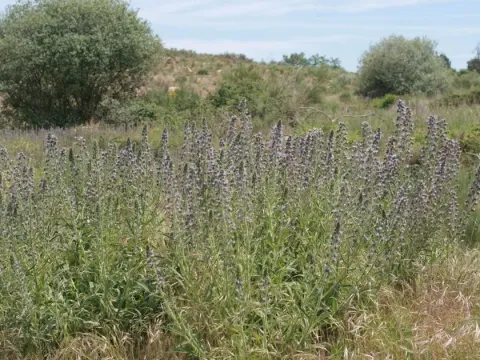
Salamanca viper's bugloss
Echium salmanticum
Echium salmanticum belongs to the Boraginaceae family and is recognized as a hardy biennial or perennial plant in agricultural contexts. Sowing is typically performed in early spring once the soil temperature is stable at around 10 degrees Celsius.
What the section contains
Salamanca viper's bugloss
Seeds are small and dense, requiring a shallow planting depth of approximately 1 to 2 centimeters to ensure successful germination and seedling emergence.
Field cultivation practices often employ row seeding with inter-row spacing of 40 to 50 centimeters to facilitate mechanical weeding and ensure optimal air circulation.
For large-scale cultivation, the use of precision seeders is recommended to maintain the correct seed density, preventing overcrowded spots that could hinder individual plant development.
Winter sowing is also a viable option in milder climates, allowing seeds to naturally stratify and emerge early in the spring, making use of residual winter soil moisture.
This crop thrives in well-drained, porous soils, including sandy and rocky substrates where other crops might struggle to establish a robust root system.
It is exceptionally drought-tolerant but is sensitive to waterlogging; therefore, selecting sites with proper drainage is essential for long-term stand vitality.
Full sun exposure is mandatory for maximum nectar secretion and vegetative health, as any degree of shade tends to reduce the plant's overall productivity.
The plant performs best in neutral to slightly alkaline soil conditions, which support the efficient uptake of essential nutrients and promote vigorous flowering.
Agricultural inputs like nitrogen fertilizers should be used sparingly, as excessive fertility can promote unwanted leafy growth at the expense of the desired floral production.
The primary economic value of Salamanca viper's bugloss lies in its role as a high-quality honey plant, providing abundant nectar for honeybee populations.
Yield potential is dependent on summer rainfall patterns, yet the crop remains one of the most reliable sources of nectar during dry periods when other sources fail.
Beyond beekeeping, the plant acts as a beneficial ground cover, its deep taproot helping to loosen compacted subsoil and improve overall soil aeration.
While not a primary forage crop, the foliage can be utilized in mixed green manures to add organic matter back into degraded or low-nutrient agricultural lands.
Strategic management of flowering periods allows for continuous harvests, maximizing the duration of the nectar flow for local apiaries throughout the summer months.
Fungal diseases, particularly powdery mildew, pose the most significant risk to the crop, especially in conditions characterized by high humidity and poor air circulation.
Insects like weevils can damage flower buds during the early development stages, which directly impacts the yield potential and nectar secretion of the plants.
Weed competition during the germination phase is a major threat; effective control through mechanical cultivation is necessary until the plants form a closed canopy.
Given the importance of this plant for pollinators, the use of pesticides must be strictly managed, with a preference for selective biological control methods.
Implementing a proper crop rotation strategy helps to prevent the buildup of soil-borne pathogens and minimizes the impact of potential pest outbreaks.
The harvest of seeds is timed to coincide with the physiological maturity of the plant, indicated by the browning of the seed stalks and hardened fruit coats.
Given the risk of natural shattering and seed dispersal, harvesting should be performed during the coolest, driest parts of the day to minimize yield losses.
Post-harvest processing involves drying the seeds on specialized platforms or in ventilated barns to ensure moisture content is reduced to safe storage levels.
Cleaning operations are essential to remove chaff and small debris, which could otherwise introduce moisture and promote the growth of molds during the storage phase.
Properly cleaned and dried seeds remain viable for several years if stored in a cool, dark, and dry environment, ensuring their utility for future planting seasons.