
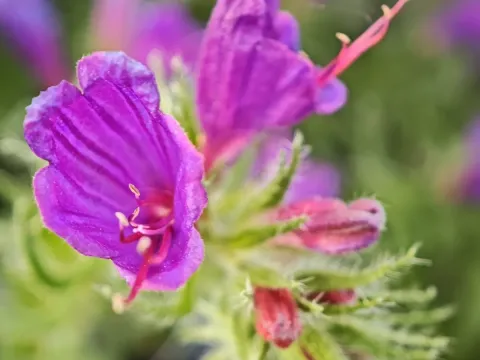
Sand bugloss
Echium sabulicola
Sand bugloss (Echium sabulicola) is a resilient crop that thrives in sandy soils and arid conditions. Sowing is typically carried out in early spring as soon as the soil warms up to 6–8 degrees Celsius, which is sufficient to initiate uniform germination in the sandy substrates favored by this species.
What the section contains
Sand bugloss
Late autumn sowing is also a viable practice, allowing seeds to undergo natural stratification over the winter. This method often results in early spring emergence, enabling the plants to establish a strong root system before the onset of the intense heat typical of late spring and summer months.
To ensure optimal stand density, seeding rates must be carefully controlled. A standard row-seeding method with row spacing of 30 to 45 centimeters is recommended, as it facilitates proper plant development and allows for mechanical weeding in the initial growth phase.
The planting depth is crucial for this species; seeds should be sown at a depth of approximately 1.5 to 2 centimeters. Because sandy soils lose moisture quickly, ensuring deep enough placement while maintaining contact with the moist soil layers is the key to achieving successful field emergence.
Rolling the soil after sowing is a highly recommended agronomic practice. This action eliminates large air pockets in the soil and promotes capillary water movement, which is essential for sustaining the delicate seedlings during their first few weeks of growth.
As a member of the Boraginaceae family, Sand bugloss is a classic xerophyte, perfectly adapted to nutrient-poor, sandy terrains. It requires very little soil fertility, making it an excellent candidate for reclaiming degraded or marginal lands where traditional crops would struggle to survive.
The plant possesses a robust taproot system that can reach deep into the soil profile. This adaptation allows the species to tap into groundwater reserves, making it exceptionally drought-tolerant and capable of maintaining vigorous growth even in the hottest and driest periods of the summer season.
Sunlight is a major requirement for this species. To achieve peak nectar production and robust biomass, Sand bugloss needs open, well-lit fields. Shade from trees or tall weeds should be avoided, as it significantly reduces both flower density and the plant's overall vitality.
In terms of soil pH, the plant is quite versatile, though it shows a preference for neutral or slightly alkaline conditions. It is highly efficient at utilizing sparse nutrients in sandy ground, and it does not require heavy fertilization to perform its primary roles as a forage or bee-friendly crop.
Managing competition from other weeds is critical, especially during the first year of life when the plant forms a basal rosette. Regular cultivation between the rows helps suppress invasive vegetation, ensuring that the Sand bugloss plants receive the necessary space and resources to thrive.
Sand bugloss is primarily esteemed in the agricultural sector as a high-value honey crop. Under optimal conditions, a single hectare of well-maintained Sand bugloss can yield between 300 and 600 kilograms of high-quality, fragrant honey, making it a strategic choice for professional beekeepers.
Beyond its beekeeping value, the species serves as a useful forage plant. When harvested during the flowering stage, the green mass can be processed into hay, providing a source of dietary roughage for livestock that is both palatable and sustainable on poor-quality soils.
Seed production is another economic aspect of this crop. Farmers can expect yields of around 4 to 6 centners per hectare. The seeds remain viable for several years if stored in cool, dry conditions, providing flexibility in planning the crop rotation and future acreage allocations.
To maximize yields, particularly for honey production, limited applications of phosphorus and potassium fertilizers can be beneficial. However, nitrogen inputs should be minimized to avoid excessive green growth, which can occasionally reduce the quantity and quality of flower production.
The long-lasting blooming period of this species makes it a stable resource for maintaining bee health during the mid-summer flow gap. Even on marginal sandy soils where productivity might be lower, the consistency of nectar secretion provides significant economic stability for the farm.
Sand bugloss is noted for its high resistance to many common agricultural diseases, which lowers the need for intensive fungicide programs. Nevertheless, in areas with persistent high humidity or poor field drainage, powdery mildew may develop, appearing as a thin white coating on the leaves.
Pest pressures primarily include specialized weevils that feed on the foliage and flower buds. These insects can reduce the vigor of the plant, potentially impacting both the seed set and the nectar production. Early detection through regular field scouting is essential for effective management.
Root damage from wireworms is a potential risk, particularly if the fields were previously established as long-term pastures or meadows. Assessing the soil for soil-borne pests before planting is a fundamental step in ensuring a successful crop establishment in such areas.
Integrated pest management strategies should focus on preventive measures, such as proper crop rotation and the destruction of wintering sites for insects. Deep autumn plowing is an effective way to expose larvae to frost and birds, significantly reducing the pest population for the following year.
Chemical control should be employed only as a last resort, strictly adhering to environmental safety guidelines. Because the crop is a primary attractant for pollinators, the use of pesticides during the flowering season is strictly prohibited to prevent harm to honeybee colonies.
Harvesting Sand bugloss for seed production requires careful timing. The seeds mature unevenly within the flower spikes, so the optimal window is when the lower parts of the spikes have turned brown, while the upper parts show signs of nearing maturity.
The two-stage harvest method is the industry standard. The crop is first swathed and left in the field to dry for several days, which allows the seeds to finish maturing through the plant's remaining sap, effectively minimizing shattering losses during the final harvest.
After the swaths are sufficiently dry, a combine harvester is used to thresh the crop. Precise calibration of the reel and the drum speed is necessary to prevent mechanical damage to the seeds, and airflow should be set carefully to ensure effective separation of chaff from the grain.
Post-harvest, the seed material must be cleaned and dried to a moisture content of 12-14%. Proper storage in well-ventilated, dry facilities is mandatory; storing seed in high-moisture conditions will almost certainly lead to mold and a rapid decline in germination rates.
When harvesting for green fodder, timing the cut at the peak of the flowering period ensures the highest nutritional concentration. After cutting, the biomass should be dried properly to preserve its vitamin profile, resulting in high-quality hay suitable for winter feeding programs.