
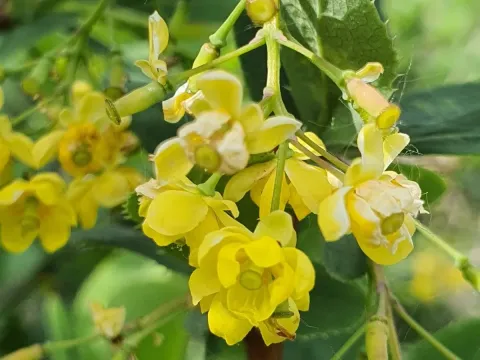
Amur barberry
Berberis amurensis
Amur barberry is typically propagated by seeds or vegetative methods. Sowing seeds directly into the soil is best done in late autumn to ensure natural stratification through the winter months.
What the section contains
Amur barberry
For spring sowing, seeds must undergo cold stratification at temperatures between 1 and 5 degrees Celsius for 3 to 4 months. They are sown at a depth of 1 to 2 centimeters in light, sandy soil.
Vegetative propagation is commonly achieved via softwood cuttings taken during the early summer. These cuttings require high humidity and regular misting to successfully develop roots.
Layering is another reliable method: low-hanging branches are pinned to the ground and covered with soil in the spring, allowing roots to form over the course of the growing season.
Division of the mature root system can be performed in early spring or late autumn when the plant is dormant, ensuring each section has healthy roots and stems.
Amur barberry, or Berberis amurensis, belongs to the Berberidaceae family. It is a large deciduous shrub native to the Far East, China, and Japan, known for its strong growth habit.
The plant thrives in full sun but can tolerate partial shade. Full exposure to sunlight is essential for optimal berry production and for maintaining the vibrant green foliage during the summer.
It prefers well-drained, fertile soil. While it is adaptable to various soil types, it performs best in neutral to slightly alkaline environments and does not tolerate waterlogged ground.
The species is highly frost-hardy and requires minimal winter protection, making it an excellent choice for northern climates where other ornamental shrubs might struggle.
Regular maintenance including pruning is required to keep the shrub in shape. It responds well to heavy pruning, which helps maintain the desired hedge density or growth size.
The Amur barberry is primarily valued for its edible, vitamin-rich berries. These fruits are high in ascorbic acid and are used to create jams, juices, and various culinary seasonings.
Proper cultivation, including adequate spacing between bushes and balanced fertilization, can significantly increase the total harvest volume per plant.
The fruits serve both commercial pharmaceutical purposes and domestic culinary uses. Harvesting is typically done in the fall once the berries have reached their peak sugar content.
In addition to food production, the shrub is widely used in landscape architecture. Its dense, thorny branches provide excellent security hedging and windbreaks for agricultural fields.
Strategic pruning of old wood improves the overall vigor of the bush, which directly results in better flowering and, consequently, higher annual fruit yields.
Powdery mildew is the most common fungal disease affecting Berberis amurensis, characterized by a white, dusty coating on the leaves and young succulent stems.
Rust can also affect the plants, often leading to the formation of orange-colored spots on the underside of the leaves. It is advised to avoid planting near cereal crops due to cross-infection risks.
Aphids are the primary insect pests, colonizing new growth and causing curling or yellowing of the leaves. They can be controlled using soft insecticidal soaps or systemic pesticides.
Barberry sawfly larvae can defoliate entire branches if left unchecked. Regular visual inspections are recommended to catch infestations before they cause significant aesthetic or physiological damage.
Root rot is a potential risk in poorly drained soils. Maintaining good aeration and avoiding over-irrigation are critical practices to prevent the development of anaerobic conditions around the roots.
The harvest period usually begins in September or October. Fruits should be gathered when they turn a uniform, deep red color and become slightly soft to the touch.
Caution must be exercised during the harvest due to the sharp thorns present on the branches. Using thick gloves or specialized tools to cut the fruit clusters is recommended.
Post-harvest, the berries should be processed quickly. They can be dried, frozen, or made into preserves to retain their nutritional value and tart flavor profile.
Clean the berries of any plant debris and spread them in thin layers for drying to prevent mold growth in the early stages of storage.
Leaving a portion of the harvest on the bush can provide a valuable winter food source for local bird populations, which is an ecological benefit in mixed-use garden landscapes.