
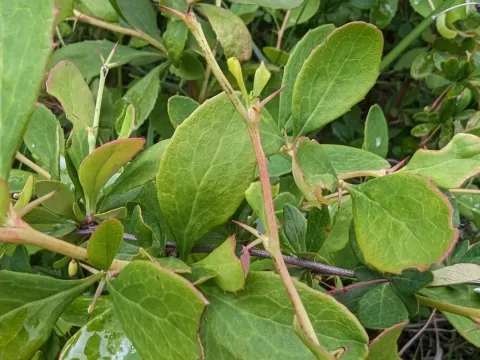
American barberry
Berberis canadensis
Propagation of Berberis canadensis is primarily carried out through seeds or vegetative methods such as cuttings. Seeds require mandatory stratification for 3-4 months at low temperatures to ensure high germination rates in the spring.
What the section contains
American barberry
Sowing seeds in open ground is performed before winter, which allows the seeds to undergo a natural hardening cycle. The sowing depth is 1-2 centimeters, with rows spaced at least 20-30 centimeters apart to support proper root system development.
Cuttings are taken during the summer period using semi-hardwood shoots of the current year. To enhance rooting, cuttings are treated with growth stimulants and planted in a lightweight substrate under a plastic cover to maintain high humidity.
For the first two years, seedlings require special attention, including regular weeding and moderate watering. After reaching the age of two, plants can be transplanted to their permanent location, following a specific spacing scheme for hedges or clusters.
Transplanting young plants to their permanent site is best performed in early spring before sap flow begins or during the autumn when the plant is in a state of biological dormancy.
The American barberry is a deciduous shrub belonging to the Berberidaceae family, valued for its high frost resistance and low maintenance. Naturally, it inhabits North America, preferring open woodland borders and rocky slopes.
The crop has moderate soil requirements but thrives best in well-drained, loamy substrates with a neutral or slightly alkaline pH. The plant is highly sensitive to waterlogging, which can lead to root crown rot if soil drainage is poor.
Sunny conditions are essential for the normal development of the barberry. In the shade, the shrub's ornamental value decreases, foliage loses its vibrant color, and flowering becomes less intense, which negatively impacts fruit production.
The plant is known for its drought tolerance and can withstand extended periods without rainfall due to its strong root system. However, for a high-quality berry harvest, occasional watering is required during prolonged dry spells.
This shrub adapts well to urban environments and is resistant to air pollution and dust. The optimal temperature range for active growth is between 18-25 degrees Celsius, though it can survive harsh winters without the need for additional protection.
The primary threat to the American barberry is powdery mildew, which appears as a white coating on the leaves. Controlling it involves the use of sulfur-based fungicides and timely thinning of the crown to improve air circulation.
The barberry aphid is a common pest that extracts sap from young shoots. In cases of mass infestation, systemic insecticides are applied, whereas minor infestations can be managed using soapy water or insecticidal herbal decoctions.
Rust infection is also possible, appearing as orange spots on the leaves. Since barberry acts as an alternate host for certain rust fungi, it is strongly advised not to plant it in close proximity to cereal crops.
Bacteriosis is a serious condition that causes bark cracking and branch wilting. Affected parts of the shrub must be removed immediately and destroyed by fire to prevent the infection from spreading across the site.
Disease prevention is based on adhering to standard horticultural practices, such as proper spacing to avoid overcrowding and the timely removal of dead or diseased branches through sanitary pruning.