
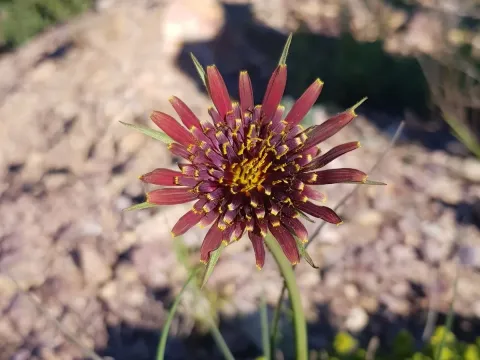
Purple salsify
Tragopogon crocifolius
Purple salsify is typically sown in early spring, as soon as the soil is workable and has reached a temperature of at least 5 to 8 degrees Celsius.
What the section contains
Purple salsify
For earlier crop production, sowing can be done in late autumn, allowing the seeds to undergo natural winter stratification for better germination.
Seeds should be planted at a depth of 2 to 3 centimeters in well-prepared, loose soil to facilitate the proper formation of the taproot.
The recommended row spacing is 30 to 40 centimeters, with thinning to ensure each plant has about 15 to 20 centimeters of space within the row.
Proper seedbed preparation is essential to prevent crusting, which can impede the emergence of young sprouts and lead to uneven plant stands.
This member of the Asteraceae family thrives in sunny locations with deep, light, and sandy-loam soils that allow for unobstructed root development.
It is sensitive to soil compaction, which often causes the roots to become twisted, woody, or stunted, significantly reducing their culinary value.
A soil pH between 6.5 and 7.5 is ideal; excessive nitrogen, particularly from fresh manure, should be avoided to prevent root rot and foliage overgrowth.
While the plant is relatively drought-tolerant, consistent moisture levels during the peak growing season are necessary for crisp and tender roots.
Rotation is critical, and the crop should not be planted immediately after other Asteraceae members to avoid the buildup of common soil-borne pathogens.
Tragopogon crocifolius is a biennial plant that produces a fleshy, nutritious taproot in its first year, which is the primary part harvested for consumption.
In optimal conditions, growers can expect a substantial yield, often reaching 2 to 2.5 kilograms per square meter of cultivated garden area.
The roots are highly valued for their delicate, oyster-like flavor and are a rich source of inulin, making them an excellent choice for dietary vegetable needs.
Beyond the roots, the young leaves can be harvested throughout the season and used in salads as a vitamin-rich green addition to the diet.
Consistent care, including weeding and supplemental mineral feeding, directly impacts the quality and volume of the yield obtained at the end of the season.
Powdery mildew and various fungal rots are the most common diseases, particularly in humid climates with poor air circulation between rows.
Pests like aphids and root-dwelling nematodes can cause significant damage, weakening the plant and increasing its susceptibility to further infections.
Integrated pest management, including the use of biological control agents and crop rotation, is the best strategy for maintaining a healthy planting.
Regular monitoring of foliage for signs of chlorosis or spot development is necessary to intervene before a widespread infestation occurs.
Good soil drainage is the most effective preventative measure against many of the fungal threats that target this root vegetable during the growth cycle.
Harvesting usually occurs in late autumn, approximately 120 to 150 days after sowing, once the plant foliage begins to yellow and die back naturally.
Careful digging using a garden fork is necessary to extract the full length of the root without breaking it, as damage leads to rapid quality decline.
Once lifted, the roots should be cleaned of excess soil, trimmed of greens, and allowed to cure in a shaded, ventilated area for a short period.
Storage for winter requires cool, high-humidity conditions, typically achieved by placing the roots in boxes filled with slightly moist sand.
If kept at temperatures near freezing, the roots can remain fresh and crisp for several months, providing a source of nutrition throughout the winter.