
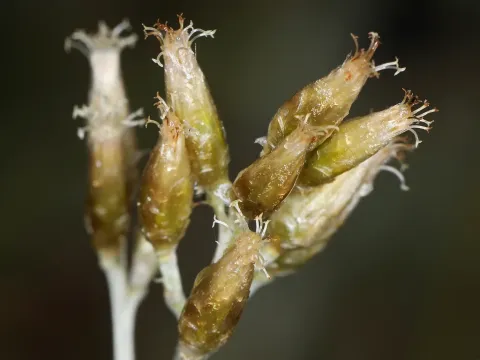
Pussytoes
Antennaria
Sowing Antennaria seeds is typically performed in early spring, around March or April, using a seed-starting tray. Because the seeds are tiny, they should be surface-sown on a well-draining medium and pressed lightly into the soil without being covered.
What the section contains
Pussytoes
The optimal germination temperature ranges between 18 and 20 degrees Celsius. Once seedlings emerge, which takes about two to three weeks, they must receive sufficient light to prevent them from becoming spindly or weak.
Transplanting into the garden should occur in early June, once all danger of frost has passed. Plants should be spaced 20 to 30 centimeters apart to allow enough room for their characteristic mat-forming habit to develop fully.
Vegetative propagation is an efficient alternative, usually performed by dividing mature mats in late summer or early autumn. This method ensures that the new plants retain the exact characteristics of the parent, including foliage color and flowering patterns.
When dividing, ensure that every segment has a healthy root system and at least a few rosettes. After planting the divisions, it is crucial to keep the soil consistently moist for a few weeks until the roots are well established in their new location.
Antennaria, commonly known as Pussytoes, belongs to the Asteraceae family and is a resilient perennial herb. It is highly valued for its silvery, woolly foliage, which provides excellent texture in rock gardens and alpine borders.
The plant thrives in poor, sandy, or rocky soil conditions, making it an excellent candidate for areas where other plants might struggle. Excellent drainage is non-negotiable, as standing water will inevitably lead to root decay.
As a sun-loving plant, it requires full exposure to sunlight to maintain its dense, cushion-like growth form. In shaded environments, Pussytoes tend to lose their structural compactness, become elongated, and produce significantly fewer flowers.
Pussytoes are remarkably hardy and can withstand severe winter temperatures without needing any specialized winter protection. They are well-adapted to windy and exposed sites, surviving harsh conditions that would kill more sensitive species.
Once established, the plant is quite drought-tolerant. Irrigation is generally unnecessary except during prolonged periods of summer drought or immediately after planting, when the root system is still developing in the surrounding soil.
The most significant threat to the survival of Antennaria is soil saturation. When grown in heavy clay or low-lying areas where water pools, the roots become susceptible to fungal rot, which can destroy an entire patch in a short time.
If humidity remains high and air circulation is poor, the foliage may develop powdery mildew. Preventing this requires proper plant spacing and ensuring the area is free from aggressive weeds that could trap moisture against the leaves.
Slugs can occasionally cause damage to the foliage during rainy weather. Surrounding the plants with a layer of grit or fine gravel is a common and effective organic method to deter these pests from reaching the foliage.
Insects like aphids are rare pests for this species, but they can occasionally appear on the flower stalks. If an infestation occurs, manual removal or a mild insecticidal soap application is usually sufficient to resolve the issue.
Avoid excessive nitrogen fertilizer application, as this promotes succulent, rapid growth that is weak and highly prone to diseases. Keeping the plant in nutrient-poor soil is actually beneficial for its long-term health and stability.