
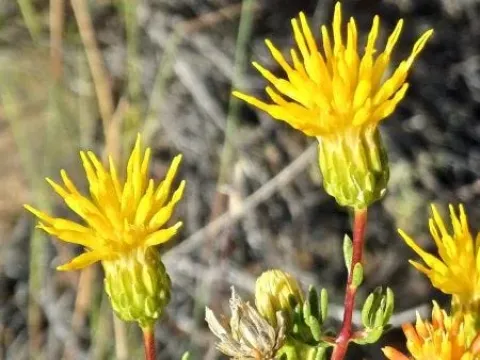
Pteronia
Pteronia
Pteronia is a genus of perennial shrubs belonging to the Asteraceae family. These plants are primarily native to the arid and semi-arid regions of Southern Africa, where they have adapted to harsh environmental conditions.
What the section contains


Pteronia
The cultivation of Pteronia requires well-drained, porous soil types. They are highly intolerant of waterlogging, which often results in root rot and plant mortality, making sandy or rocky soils the most suitable for their establishment.
These plants are adapted to Mediterranean and desert-like climates characterized by seasonal rainfall patterns. They require high levels of solar irradiance for optimal photosynthesis and the production of secondary metabolites.
In terms of agricultural management, Pteronia does not require intensive fertilization. It is well-adapted to nutrient-poor soils and may suffer from over-fertilization, which encourages excessive leaf growth at the expense of structural integrity.
Crop spacing is critical for Pteronia to ensure that each plant has sufficient access to soil moisture. Overcrowding can lead to increased competition for water during periods of prolonged drought.
The primary economic use of Pteronia lies in its role as a browse plant for livestock. In the Karoo region, it serves as a staple forage for small stock, particularly during seasons when other vegetation is unavailable.
Yields of biomass are generally low compared to conventional forage crops, reflecting the plant's adaptation to energy conservation. However, its longevity as a perennial shrub provides a reliable source of browse over several years.
Beyond forage, the plant contributes significantly to soil stabilization. Its root system helps hold loose soil in place, reducing the impact of wind erosion in degraded environments.
Recent research highlights the chemical profile of Pteronia, suggesting potential applications in the medicinal and chemical industries due to the presence of specific terpenes and flavonoids.
Harvesting strategies are usually based on grazing management. Controlled, rotational grazing is essential to prevent over-utilization and ensure that the plant retains enough photosynthetic capacity to regenerate.