
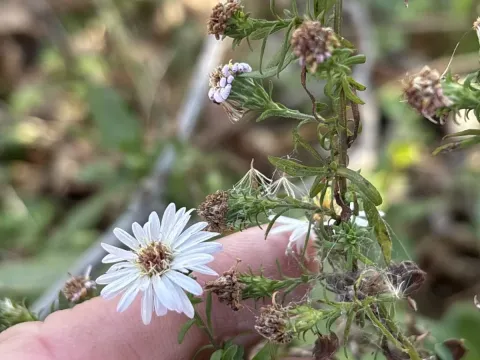
Aster
Symphyotrichum
Sowing seeds of perennial asters (Symphyotrichum) for seedlings is typically carried out in late winter or early spring to ensure robust plant establishment.
What the section contains
 Amethyst aster
Symphyotrichum x amethystinum (Nutt.) G. L. Nesom
Amethyst aster
Symphyotrichum x amethystinum (Nutt.) G. L. Nesom
 Aromatic aster
Symphyotrichum oblongifolium (Nutt.) G. L. Nesom
Aromatic aster
Symphyotrichum oblongifolium (Nutt.) G. L. Nesom
 Heath aster
Symphyotrichum ericoides (L.) G. L. Nesom
Heath aster
Symphyotrichum ericoides (L.) G. L. Nesom
 Hybrid Aster
Aster pringlei x novi belgii
Hybrid Aster
Aster pringlei x novi belgii
 New England aster
Symphyotrichum novae-angliae (L.) G. L. Nesom
New England aster
Symphyotrichum novae-angliae (L.) G. L. Nesom
 New York aster
Symphyotrichum novi-belgii (L.) G. L. Nesom
New York aster
Symphyotrichum novi-belgii (L.) G. L. Nesom
 Pringle's hairy aster
Symphyotrichum pilosum (Willd.) G. L. Nesom var. pringlei (A. Gray) G. L. Nesom
White heath aster
Symphyotrichum pilosum (Willd.) G. L. Nesom
Pringle's hairy aster
Symphyotrichum pilosum (Willd.) G. L. Nesom var. pringlei (A. Gray) G. L. Nesom
White heath aster
Symphyotrichum pilosum (Willd.) G. L. Nesom
Aster
For direct seeding in the field, it is recommended to sow seeds in early spring once the soil temperature is consistently above 10 degrees Celsius.
Winter sowing is also a viable strategy, where seeds are broadcast in late autumn, allowing for natural stratification and early spring germination.
The sowing depth should be shallow, generally between 0.5 and 1 cm, as many species require light to trigger optimal germination.
Proper spacing is crucial; plants should be set 30–60 cm apart depending on the specific species' spread to allow for sufficient air circulation.
Asters belong to the Asteraceae family and thrive in full sun locations, although they demonstrate adaptability to partial shade conditions.
They prefer well-drained, fertile soil with a neutral pH level, avoiding heavy clay soils that are prone to waterlogging and root rot.
Water management is vital; while established plants are somewhat drought-tolerant, consistent moisture is necessary during the bloom development phase.
These plants are highly frost-hardy and thrive in temperate climates, making them a staple for late-season landscaping and cut-flower production.
Soil fertility can be managed with a balanced fertilizer application in the spring, avoiding excessive nitrogen which leads to weak stems.
The yield of cut flower stems is significantly influenced by the level of maintenance, specifically regular deadheading and pest monitoring.
A well-maintained aster bed can produce high-quality, long-lasting flowers over an extended period from late summer through late autumn.
Optimizing plant density helps maximize flower production per unit area, provided that plants are not overcrowded, which reduces quality.
Harvestable yield increases as the root system establishes over the first few years, resulting in a fuller, more prolific plant growth.
Strategic variety selection allows for a staggered harvest schedule, ensuring a consistent supply of fresh stems throughout the late growing season.
Fusarium wilt is a common soil-borne disease that can devastatingly impact aster plantations by obstructing nutrient and water transport.
Powdery mildew is frequently observed during late summer when humidity levels fluctuate, showing as white patches on the foliage.
Pests like aphids and spider mites can cause significant damage, especially in dry conditions, weakening the plant and spreading viruses.
Integrated Pest Management (IPM) practices, including the use of neem oil or insecticidal soaps, are effective for controlling minor pest outbreaks.
- Maintain proper spacing between plants to decrease local humidity levels.
- Use certified disease-free seeds or starts to prevent field contamination.
- Sanitize tools regularly to stop the transmission of plant pathogens between rows.
Cut flowers should be harvested when the bloom is partially open, ensuring that the plant remains productive for subsequent stems.
Cutting should be performed during the coolest part of the day to ensure maximum hydration and increase the vase life of the floral product.
Using clean, sharp shears prevents crushing the stems, which can impede water uptake and shorten the life of the harvested flowers.
Immediately place cut stems into clean water and store them in a cool environment to maintain quality before they are packaged for market.
Seed harvesting should occur after the florets have faded and the center of the flower has fully matured and begun to dry out on the stalk.