
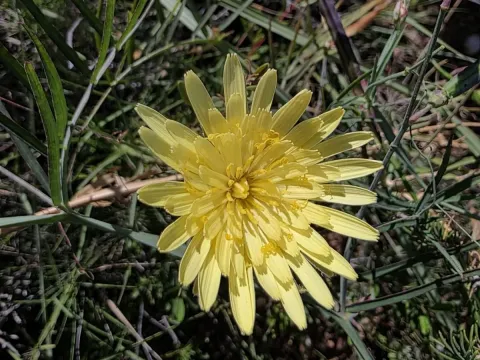
Narrowleaf black salsify
Scorzonera angustifolia
Narrowleaf black salsify, a member of the Asteraceae family, is sown directly into the soil. The optimal time for sowing in temperate regions is early spring, as soon as the soil warms up to at least 5–8 degrees Celsius.
What the section contains
Narrowleaf black salsify
The seeds of this crop have high germination energy, so they should be sown at a depth of 2–3 centimeters. Row spacing should be at least 30–40 centimeters to ensure the full development of the leaf rosette.
For an early harvest, late autumn sowing is possible. In this case, the beds must be mulched with a layer of peat or compost to protect the seeds from premature germination during short winter thaws.
Sowing density is a critical factor for success. Seedlings should be thinned out when they develop two true leaves, maintaining an interval of 10–15 centimeters between plants in the row to allow for large root development.
Although it is a perennial plant, it is cultivated as an annual or biennial for agricultural purposes. In the first year, the plant focuses on developing the root, which resembles a narrower version of the common black salsify.
The plant prefers sunny areas with light, structural soils. Sandy loam or loam soils with a deep arable horizon are ideal, which is crucial for the proper formation of the long, cylindrical roots.
Narrowleaf black salsify is quite demanding regarding soil moisture. During dry periods of vegetation, regular watering is essential, otherwise, the roots may become tough, bitter, and lose their culinary value.
This crop does not tolerate waterlogging; therefore, areas with high groundwater levels are unsuitable. Under such conditions, roots are prone to decay and deformation, which significantly reduces their storage potential.
The optimal soil pH should be neutral to slightly acidic (6.5–7.0). Fresh manure application directly before planting is not recommended as it promotes root branching and spoils the visual quality of the harvested roots.
The plant exhibits high cold hardiness and can withstand significant temperature fluctuations. This makes it a promising crop for northern regions where other root vegetables might be damaged by late spring frosts.
The agricultural value of Narrowleaf black salsify lies in its nutritional composition. The roots are rich in inulin, B vitamins, and essential minerals, making them a valuable dietary product for healthy nutrition.
Yield depends on cultivation techniques, soil preparation, and plant density. When all requirements are met, one square meter of plantation can produce between 1.5 and 2.5 kilograms of high-quality marketable roots.
In the kitchen, the plant is used as an asparagus substitute or a side vegetable. Thanks to its delicate taste and light nutty aroma, it is popular in dietary menus for its metabolism-boosting properties.
Regular weeding and inter-row cultivation are necessary to maintain yield. This promotes root system aeration and prevents the formation of soil crust, which restricts the radial growth of the roots.
Commercial cultivation requires mechanized processing, especially during harvest, as long and brittle roots are easily damaged. In home gardening, harvesting is usually performed by hand using garden forks.
The most dangerous diseases for this crop are fungal rots, particularly white and gray root rot. These develop when soil moisture levels are poorly managed or when the soil becomes excessively compacted.
Among pests, wireworms cause the most significant damage by boring into the roots, making them unsuitable for storage. Control strategies involve crop rotation and the timely removal of weeds from the field.
Aphids may infest the leaf rosettes during hot weather, sucking sap and stunting the plant's growth. Biological pesticides that are safe for vegetable crops are recommended for pest population management.
Mole crickets pose a serious threat to young seedlings by gnawing on the roots. Preventive measures include using traps and baits placed around the perimeter of the field before the start of the growing season.
Disease prevention includes treating seeds before sowing and maintaining optimal phytosanitary conditions. It is important to avoid overcrowding the plants, as poor air circulation can encourage the development of mold fungi.
Harvest time for Narrowleaf black salsify begins when the roots reach market maturity. This usually occurs 120–150 days after germination, when the leaves start to turn yellow and wither.
Harvesting should be performed in dry weather, which simplifies soil removal and improves the shelf life of the roots. Once lifted, roots are left on the bed for a few hours to dry, away from direct sunlight.
The roots are very fragile, and any mechanical damage to the skin can lead to rapid moisture loss. Therefore, it is important to use tools that deeply undercut the soil without touching the body of the vegetable.
After harvesting, the roots are sorted, and damaged specimens are removed. The tops should be carefully trimmed, leaving a small stump of 1–2 centimeters to prevent sprouting during long-term storage.
Store the roots in a cool room or cellar at temperatures near 0...+2 degrees Celsius. To prevent shriveling, they should be covered with moist sand, which keeps the product fresh until the spring season.