
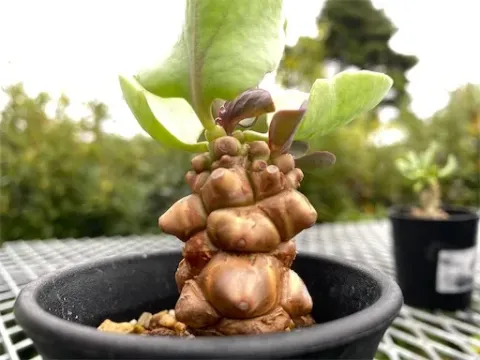
Othonna herrei
Othonna herrei
Propagation of Othonna herrei is primarily achieved through seeds sown in late winter. Using a well-draining mineral-based substrate is essential for successful germination.
What the section contains
Othonna herrei
Seeds should be covered with a very thin layer of grit to provide stability and maintain the necessary humidity levels during the initial stages of seedling development.
Cuttings can be taken during the active growing season, which for this species typically falls within the cooler months. The cut must be allowed to callous thoroughly.
Once calloused, the cuttings are placed into dry, porous sand to encourage root development without the risk of rot, which is common in more humid mediums.
Temperature control is vital during the propagation phase; maintaining a stable range between 20°C and 25°C will yield the best results for vegetative growth.
Othonna herrei is a slow-growing, highly sought-after succulent species from the Asteraceae family, native to the arid rocky habitats of Namibia and South Africa.
This species is valued for its thick, gnarly caudex and succulent, waxy stems, requiring intense sunlight to maintain its characteristic compact, architectural form.
The potting mix must be highly inorganic, consisting of pumice, lava rock, and coarse sand. Peat or heavy organic components should be avoided to prevent root suffocation.
The plant follows a winter-growing cycle. It requires regular water during the cooler months and enters a strict dormancy period throughout the hot summer months.
During the summer dormancy, the plant must be kept completely dry and in a location with good air circulation to prevent excessive heat accumulation around the base.
The most significant threat to Othonna herrei is overwatering, especially during the dormancy phase, which rapidly leads to devastating fungal and bacterial rot.
Mealybugs are the primary pest concern for this species, often clustering in the crevices of the stems where they are difficult to reach with standard contact sprays.
Poor ventilation and high atmospheric humidity can predispose the plant to various mold infections that attack the epidermis of the thick, succulent stems.
Root aphids may also be present in the root zone if the soil composition is not sufficiently mineral or if standard potting soil was mistakenly used.
Treatment involves the use of systemic insecticides for pests, while fungal issues require the removal of affected areas and the application of fungicides.