
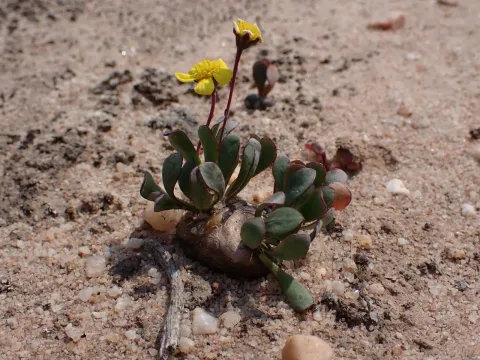
Othonna carnosa
Othonna carnosa
Othonna carnosa is a succulent plant belonging to the Asteraceae family. Native to the arid regions of Southern Africa, it has evolved specific physiological adaptations to thrive in environments with erratic rainfall and high sun exposure.
What the section contains
Othonna carnosa
The propagation of this crop via seeds requires a sterile, well-draining substrate. Seeds should be sown on the surface and lightly pressed, maintaining a temperature range of 20°C to 25°C to ensure successful germination within a few weeks.
Vegetative propagation is achieved through stem cuttings. Allowing the cut surfaces to callous for several days before planting is a fundamental agronomic practice that prevents pathogens from entering the plant tissue and causing rot.
For optimal growth, seedlings require high light levels immediately after sprouting to prevent etiolation. A balanced, dilute nutrient solution can be provided once the plants have established a robust root system, supporting healthy development.
In terms of agricultural and horticultural utilization, Othonna carnosa is primarily valued for its resilience and unique aesthetic, making it an excellent candidate for xeriscaping and container gardening in appropriate climatic zones.
The primary environmental requirement for Othonna carnosa is exposure to full, bright sunlight. As a succulent, it needs intense light to maintain its compact growth form and to properly facilitate its metabolic processes in the fleshy leaves.
The soil structure must be extremely porous. A mixture of horticultural grit, perlite, and coarse sand with a minimal amount of organic matter creates the necessary conditions to prevent the saturation of the root zone, which is critical for health.
Climatic preferences include warm days and cooler nights, mimicking its natural habitat. It is not frost-tolerant and should be protected from temperatures below 10°C to prevent cellular damage and ensure plant longevity.
Watering frequency should strictly follow the 'soak and dry' method. Water should be applied only when the growing medium has dried out completely; excessive moisture is the leading cause of failure in cultivating this species.
Fertilization is recommended only during the active growth season. A low-nitrogen, high-potassium fertilizer helps encourage structural integrity rather than soft, rapid growth, which makes the plant more susceptible to pests and diseases.
Root rot caused by fungal pathogens remains the most significant threat to the crop. This condition is almost exclusively the result of overwatering or inadequate drainage, leading to the rapid decay of the basal stem.
Mealybugs are the most persistent pests affecting this plant. They tend to cluster in the leaf axils, sucking the sap and weakening the plant's immune system, which can eventually lead to stunted growth or death if not managed.
Spider mites can become an issue in environments with consistently low humidity. These microscopic pests create fine webbing and cause stippling on the succulent leaves, significantly reducing the plant's photosynthetic capacity.
Scale insects can also colonize the stems, creating hard protective coverings. Effective management requires the use of targeted systemic insecticides or manual removal, accompanied by a review of the environmental conditions to boost the plant's vigor.
- Monitor drainage levels consistently.
- Isolate infested plants immediately upon detection.
- Use systemic fungicides only when clear symptoms of infection appear.