
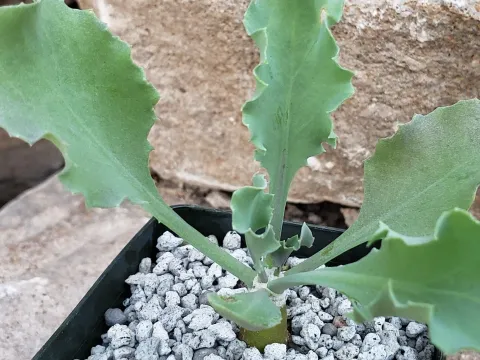
Othonna cremnophila
Othonna cremnophila
Othonna cremnophila is a perennial succulent species belonging to the Asteraceae family. Native to the arid, rocky terrains of South Africa, this plant has developed specialized adaptations to survive in harsh, drought-prone environments, often anchoring itself within narrow rock crevices.
What the section contains
Othonna cremnophila
The botanical structure of the plant features fleshy, glaucous leaves that function as water storage units. Its growth habit is typically compact, with stems that may become woody over time, reflecting its struggle for resources in its natural, nutrient-poor, and high-temperature habitat.
Regarding cultivation requirements, this plant demands high light intensity throughout the year. In a controlled environment such as a greenhouse, proper air circulation is vital to prevent moisture accumulation around the foliage, which can quickly lead to physiological stress or decay.
Soil management for Othonna cremnophila focuses entirely on drainage efficiency. A standard potting mix is often unsuitable; instead, a highly porous mineral substrate, consisting of pumice, sharp grit, and a limited amount of inorganic soil, is required to facilitate rapid water runoff.
Economically, Othonna cremnophila serves as a specialty ornamental crop within the horticulture industry. It is highly sought after by succulent collectors and specialized nurseries, where it is cultivated for its unique architectural form, contributing to the diversity of xerophytic plants in trade.
The primary threats to this succulent are fungal root pathogens induced by waterlogging. When moisture levels are too high, the delicate root system becomes prone to rapid decay, often making the plant unsalvageable if the rot reaches the main stem or crown.
Common pests include mealybugs and spider mites, which exploit the plant during periods of low humidity. Integrated pest management, including regular inspections and the application of systemic or contact insecticides, is essential to maintain plant vigor and appearance.