
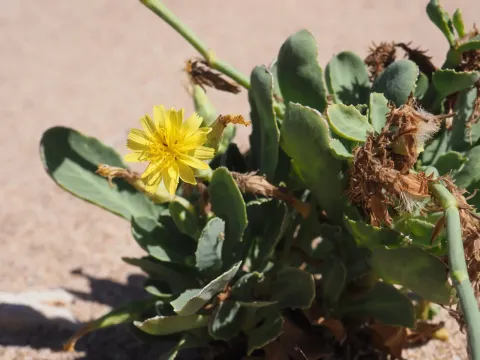
Launaea sarmentosa
Launaea sarmentosa
Launaea sarmentosa is a perennial herb belonging to the Asteraceae family. It is widely recognized as a specialized halophyte, naturally adapted to thrive in sandy coastal environments where salt stress and high wind exposure are common.
What the section contains
Launaea sarmentosa
Botanically, the plant features a prostrate habit with trailing stems that root at the nodes. This unique structural feature allows it to propagate vegetatively across sandy dunes, effectively stabilizing the substrate and acting as a natural barrier against erosion.
Regarding climate, this plant requires tropical or subtropical temperatures and thrives under full solar radiation. It is highly sensitive to light competition, meaning it must be planted in open areas to ensure adequate biomass production and healthy root development.
The soil requirements for Launaea sarmentosa emphasize the necessity of well-drained, porous, and sandy soil textures. While it is tolerant to salinity, the plant performs best in environments where moisture is maintained through ground-level contact rather than surface irrigation.
The economic utility of the crop spans from its use as fodder for livestock to its role in ethnomedicine, where its extracts are utilized for their potential anti-inflammatory properties. Its resilience makes it an ideal candidate for soil stabilization projects in coastal agriculture.
The primary threats to Launaea sarmentosa include waterlogging, which often leads to root fungal infections. Ensuring proper field drainage is the most effective management strategy to mitigate the risk of pathogen outbreaks in the root zone.
Common insect pests include aphids and mites, which are particularly prevalent during dry seasons. Agricultural producers are advised to implement integrated pest management practices to protect the integrity of the succulent leaves and stems.