
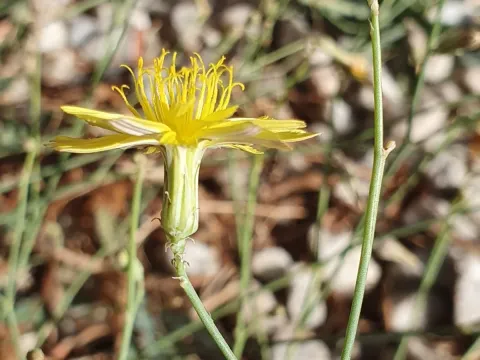
Launaea nudicaulis
Launaea nudicaulis
Launaea nudicaulis is a perennial herbaceous plant belonging to the Asteraceae family. It is a highly resilient species naturally adapted to arid and semi-arid environments, making it a subject of interest for sustainable agriculture in water-scarce regions.
What the section contains
Launaea nudicaulis
The plant is characterized by a strong taproot system that facilitates deep water uptake. Its leaves are arranged in a basal rosette, providing a compact structure that minimizes transpiration, an essential adaptation to high-temperature habitats.
Regarding soil requirements, Launaea nudicaulis thrives in sandy, gravelly, or well-drained loamy soils. It displays a remarkable tolerance to salinity, allowing it to colonize areas unsuitable for conventional staple crops.
Climatic requirements involve high solar radiation and low relative humidity. The plant is essentially drought-resistant, showing optimal performance in regions with significant heat and long intervals without measurable precipitation.
Agriculturally, this species is utilized both as a medicinal herb and as forage for livestock. Its ability to maintain biomass under harsh conditions offers a potential pathway for improving land productivity in marginal desert environments.
The primary threats to Launaea nudicaulis in an agricultural setting are fungal diseases resulting from waterlogging. Excessive irrigation or poor drainage can quickly lead to root rot, which is the most critical risk to crop viability.
Pest populations such as aphids and leaf-chewing larvae can cause significant damage to the basal rosette leaves. Consistent monitoring is necessary to prevent these pests from undermining the yield quality required for pharmaceutical uses.
Weed management is vital during the early establishment phase. As a relatively slow-growing plant, Launaea requires significant protection from invasive grasses and faster-growing weeds that compete for soil nutrients and light.
To reduce disease prevalence, growers should focus on maintaining proper spacing between plants. Good air circulation between the rosettes helps lower local humidity, effectively preventing the development of fungal spores.
Integrated pest management (IPM) practices, such as biological control agents, are recommended for large-scale production. Keeping the field environment clean and following a well-planned crop rotation strategy are the most effective ways to ensure healthy harvests.