
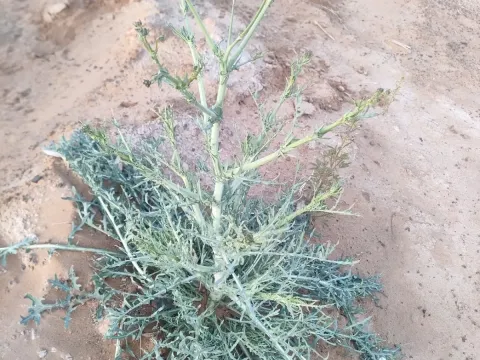
Launaea mucronata
Launaea mucronata
Launaea mucronata is a perennial herbaceous plant belonging to the Asteraceae family. It is highly specialized for survival in arid environments, often found in desert and semi-desert regions across Northern Africa and Western Asia.
What the section contains
Launaea mucronata
The plant exhibits significant morphological adaptations to drought, including a deep root system and structural modifications that reduce water loss. It typically thrives in sandy or rocky soils, showcasing remarkable tolerance to soil salinity.
Climate requirements include high solar radiation and extreme heat tolerance. As a xerophytic species, it requires very little annual precipitation, making it a critical component for restoring degraded pastures in hyper-arid zones.
Regarding cultivation, the plant requires minimal agronomic intervention. It is best suited to well-drained soils where water accumulation is avoided. Given its natural habitat, it is perfectly adapted to the harsh conditions where traditional crops would fail.
Its primary economic use is as a reliable forage source for livestock, particularly camels and small ruminants. It remains green during the dry season, providing essential nutrition when other fodder sources are scarce.
Launaea mucronata has natural defenses against many diseases due to the presence of latex in its tissues. The dry environment where it typically grows also acts as a natural barrier against most fungal pathogens.
Insects that consume the plant are generally limited to those adapted to its chemical profile. There are no major pest outbreaks documented that significantly impact the biomass yield in natural or semi-cultivated environments.
Overgrazing remains the most significant threat to the survival of this species. When livestock pressure is too high and continuous, the plant cannot recover, leading to a decline in its presence in the rangeland.
Competition from invasive species can also pose a threat if the ecosystem's balance is altered. Environmental degradation and climate shifts may impact its natural distribution and ability to compete with more aggressive non-native weeds.
Effective management involves controlled grazing cycles to ensure the plant can complete its reproductive phase. Protecting the root system from trampling during the early growing season is crucial for long-term population sustainability.