
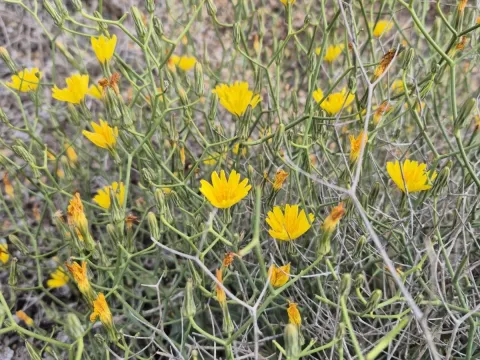
Launaea lanifera
Launaea lanifera
Launaea lanifera is a characteristic flora of arid regions, so sowing times are linked to the onset of the rainy season. Under natural conditions, seeds germinate after the first significant rainfall, once soil temperatures reach an optimal range.
What the section contains
Launaea lanifera
In agricultural practice, it is recommended to sow seeds into a well-prepared substrate at a depth of no more than 1–2 centimeters. These small seeds require delicate sowing with light rolling to ensure proper contact with soil moisture.
The optimal sowing time in arid farming occurs when the probability of late frosts is minimized. This allows the plants enough time to establish their root systems before the arrival of extreme seasonal temperatures.
A crucial requirement is to avoid water stagnation during the germination phase, as the crop is extremely sensitive to excessive moisture during its early development. Using a spaced sowing pattern is recommended to prevent intraspecific competition.
If grown under film or in greenhouses, sowing times can be shifted earlier, though hardening the seedlings before transplanting into open ground remains a mandatory step in the process.
Launaea lanifera belongs to the Asteraceae family and is a typical xerophyte, adapted to life in conditions of moisture deficiency. It is a perennial plant that possesses a high degree of resistance to intense sunlight and extreme heat.
Successful growth requires sandy or sandy-loam soils with excellent drainage capabilities. The plant tolerates soil salinity reasonably well, making it a promising candidate for the reclamation of degraded lands.
Nutrient requirements for this species are minimal. It is capable of developing in nutrient-poor areas, utilizing symbiotic associations and a deep root system to extract minerals from deeper soil horizons.
The plant demonstrates high adaptability to extreme fluctuations in night and day temperatures, typical of desert and semi-desert ecosystems. Air humidity is not a limiting factor provided there is access to minimal soil moisture reserves.
Optimal development is achieved in areas with good root zone aeration. In high-humidity soil conditions, the risk of the plant being affected by fungal diseases increases sharply.
The green mass yield of Launaea lanifera depends directly on the amount of precipitation available during the growing season. In its wild state, biomass volumes are modest, but with minimal irrigation, they increase significantly.
The main economic value lies in the above-ground part of the plant, which is used as an additional fodder source for small ruminants. Harvesting is possible during the active vegetative growth phase, before the onset of mass flowering.
Seed productivity of the species remains stable even in unfavorable years, which allows the culture to quickly restore its population in natural pastures. Harvesting is carried out mechanically or manually.
To increase commercial output, applying micronutrient fertilizers during active vegetation periods is recommended. This stimulates tillering and increases the total plant mass prior to harvest.
The economic efficiency of cultivating this crop lies in its longevity in a single location, which reduces expenses related to annual soil preparation and replanting efforts.
The primary threat to plantings is root rot, which occurs when drainage is inadequate and the soil becomes waterlogged. This is the most critical risk factor for the crop's survival in agroecosystems.
Pests, such as cutworm caterpillars and certain types of aphids, may cause localized damage by harming tender young leaves and flower buds. However, due to its specific chemical composition, the plant possesses some resistance to insects.
Fungal leaf infections, such as powdery mildew, are possible when high temperatures coincide with high relative air humidity. Preventive measures include maintaining spatial isolation between plots.
Competition from weeds is significant during the seedling stage, necessitating regular weeding in the first weeks after germination. Thereafter, mature Launaea successfully suppresses most weeds.
Livestock on free-range grazing can excessively damage young plants; therefore, pasture rotation must be managed carefully, taking into account the species' biological recovery period.