
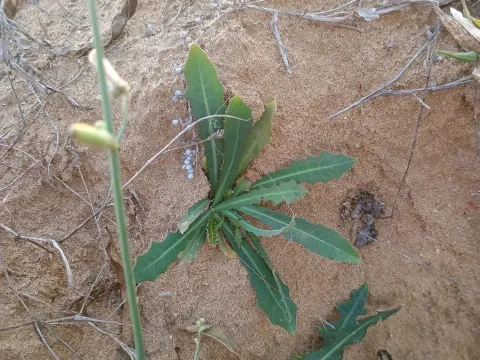
Launaea procumbens
Launaea procumbens
Launaea procumbens is a resilient perennial herb belonging to the Asteraceae family. Originating from arid and semi-arid regions of Asia and Africa, this species has evolved to thrive in environments where resource availability is severely limited.
What the section contains
Launaea procumbens
The plant exhibits a prostrate growth habit, forming dense rosettes of pinnately lobed leaves close to the ground. Its bright yellow, dandelion-like flower heads are a signature trait, making the species easily identifiable in its native arid habitats.
Optimal growth for this culture is achieved in sandy or sandy-loam soils that offer excellent drainage. Launaea procumbens is exceptionally drought-tolerant and can endure high temperatures that would prove fatal for standard high-water-demand agricultural crops.
Climatic requirements are focused on high light intensity and long daylight hours. The species is also noted for its ability to withstand saline soil conditions, marking it as a candidate for ecological restoration of degraded agricultural lands.
Beyond its ecological value, the plant is harvested for its diverse phytochemical profile. It contains valuable flavonoids and other bioactive compounds widely used in herbal medicine and traditional health supplements across its native range.
Root rot represents the most significant agricultural threat to Launaea procumbens. This condition is primarily induced by poor drainage and excessive irrigation, which create an environment conducive to fungal pathogens attacking the root system.
Common insect pests include aphids, which tend to congregate on the undersides of the leaves. Aphid infestations can weaken the plant by extracting essential sap and potentially introducing viral pathogens into the plant tissues.
Spider mites are another frequent problem, especially in dry and hot conditions where plant defenses are slightly lowered. These pests cause chlorosis and significant reduction in the photosynthetic capacity of the foliage.
Caterpillars of various moth species may also pose a threat during the vegetative growth phase. Their feeding activity can rapidly reduce the leaf area, leading to decreased vigor and lower overall harvest quality.
Effective management includes maintaining proper spacing to ensure airflow and avoiding over-watering. Using integrated pest management (IPM) strategies, including biological controls, is the recommended approach to preserving crop health.