
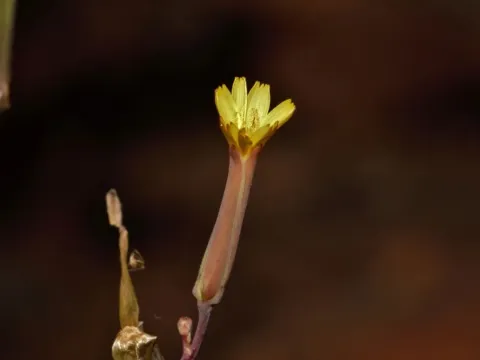
Launaea rarifolia
Launaea rarifolia
Launaea rarifolia is a perennial herbaceous plant belonging to the Asteraceae family. Within agricultural practices, this species is recognized for its significant resilience and potential as a forage crop, particularly in arid and semi-arid regions where conventional crops often fail due to water scarcity.
What the section contains
Launaea rarifolia
The plant originates from tropical Africa, where it has evolved to thrive in challenging soil conditions. Its distribution range is characterized by savanna-like environments, reflecting its ability to withstand extreme heat and inconsistent rainfall patterns throughout the vegetative cycle.
Botanically, it presents a basal rosette of leaves with a branched flowering stalk. The leaves are characteristically sparse and lobed, an adaptation that reduces transpiration rates while maximizing photosynthetic efficiency under intense direct sunlight. The inflorescence consists of yellow, ray-like florets.
The primary economic value of Launaea rarifolia lies in its utilization as livestock fodder. The biomass contains balanced levels of essential fiber and protein, serving as a reliable energy source for grazing herds when other grasses become dormant during the dry season.
Regarding health, the plant is naturally resistant to many common agricultural diseases. However, growers should monitor for specific insect infestations, particularly aphids and larvae of various Curculionidae species, which may damage the flower heads and stunt overall vegetative development.
Launaea rarifolia performs best in well-drained sandy or loamy soils. It requires full exposure to sunlight and does not tolerate competition from taller vegetation, which can lead to rapid chlorosis and subsequent death of the basal foliage.
The crop is highly tolerant of temperatures ranging from 20 to 35 degrees Celsius. While it survives in low-moisture environments, it exhibits significant yield improvements when supplemental irrigation is provided during the early establishment phase of the growing cycle.
The harvest should occur during the early bolting stage, before the full development of floral heads, to ensure the highest nutritional value and palatability. Harvesting at this stage prevents the lignification of stems and enhances the overall digestibility of the forage.
Mechanical harvesting or controlled grazing should leave enough residue for regrowth, typically maintaining a cutting height of at least 5-7 centimeters above the soil surface. This strategy ensures the longevity of the perennial root system and promotes multiple cuts within a single season.