
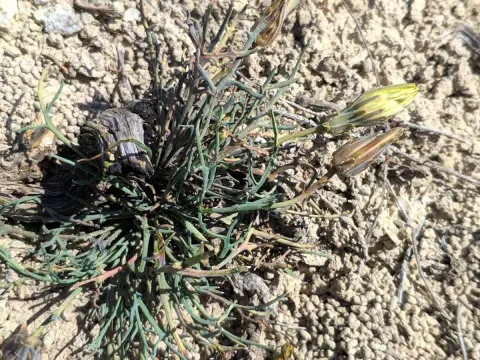
Launaea pumila
Launaea pumila
Launaea pumila is a herbaceous plant belonging to the Asteraceae family. It is increasingly recognized in agricultural research for its potential as a specialized forage crop in arid and semi-arid environments where water availability is a limiting factor for traditional farming.
What the section contains
Launaea pumila
The plant originates from the arid regions of the Middle East and North Africa. It is highly adapted to high-temperature environments, demonstrating significant tolerance to heat stress and low rainfall conditions that would typically inhibit the growth of standard pasture grasses.
Botanically, it is characterized by a dense rosette of leaves and a deep-reaching taproot system. This structure is an evolutionary adaptation that allows the plant to access moisture from subsurface soil horizons, sustaining metabolic functions throughout the dry season.
For successful cultivation, Launaea pumila requires well-drained soil types, specifically sands or sandy loams. Soil aeration is critical; waterlogged conditions are detrimental to the plant and must be avoided to prevent root rot and physiological collapse.
Agronomic management focuses on its xerophytic nature. It thrives in soils with neutral to slightly alkaline pH levels. Minimal soil disturbance is recommended to maintain soil structure, which helps the plant maintain its vigor during extreme weather fluctuations.
The primary agricultural use of Launaea pumila is as a supplemental forage source. Its nutritional composition makes it a valuable feed for small ruminants, particularly during peak summer months when other vegetation sources are scarce or depleted.
Harvesting should be timed to occur before the onset of flowering and lignification of the stems. Early harvesting ensures that the nutritional value of the biomass, particularly the protein content, remains at its peak for optimal animal digestibility.
Mechanical harvesting requires specialized equipment capable of low-profile cutting. Given the plant's growth habit, equipment must be calibrated to ensure a clean cut, preserving the crown of the plant to facilitate potential regrowth after the harvest.
Post-harvest processing involves rapid field drying. Due to the high temperature and low humidity in its native range, the biomass dehydrates quickly, allowing for efficient conversion into hay with a minimal risk of fermentation or fungal contamination.
Sustainable harvesting strategies should involve rotational grazing or selective cutting. By allowing the plants to recover sufficiently between harvests, farmers can maintain the long-term productivity of the stands, ensuring a stable forage supply for consecutive seasons.