
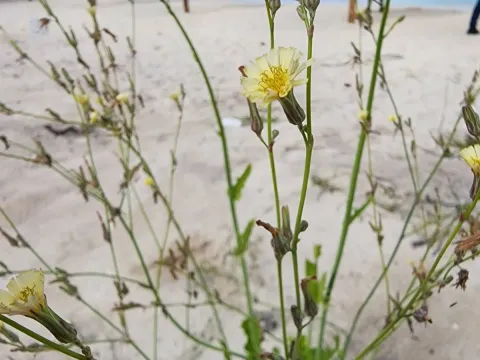
Launaea intybacea
Launaea intybacea
Launaea intybacea is a hardy plant belonging to the Asteraceae family. Sowing is typically conducted when soil temperatures are stable, ideally above 15 degrees Celsius, to ensure rapid and uniform germination.
What the section contains
Launaea intybacea
Seeds are small and should be sown at a shallow depth of 1-2 centimeters. A firm seedbed is essential to maintain sufficient moisture for the seeds during the critical establishment phase.
In rows, a spacing of 30-40 centimeters is recommended to facilitate light penetration and airflow, which minimizes the competition between individual plants.
Direct seeding in the field is the most common method, often timed to follow the first seasonal rains to utilize natural moisture for initial root development.
Succession planting can be practiced throughout the growing season to ensure a continuous supply of fresh forage or leaf mass, provided irrigation is available.
This species thrives in well-drained soils, preferring sandy or loamy textures. It is highly sensitive to waterlogging, so planting on raised beds or slopes is beneficial.
Full sun is a strict requirement for Launaea intybacea. The plant requires direct exposure to sunlight for at least 6-8 hours daily to achieve optimal growth and accumulate necessary nutrients.
It is exceptionally drought-tolerant once established, making it an excellent candidate for agricultural production in semi-arid environments where other crops struggle.
Nutrient management involves moderate nitrogen application to promote leafy biomass development. Organic compost worked into the soil before sowing provides sufficient base fertility.
The plant performs best in a temperature range between 22 and 30 degrees Celsius. Excessive heat may trigger premature bolting, while cold weather significantly retards development.
Yield potential is significant when the plant is managed properly. Harvesting leaves regularly encourages the development of multiple shoots, thereby increasing the total biomass produced per season.
For forage production, cut-and-carry systems are highly effective. Mowing the plants at a height of 15 centimeters allows for quick regrowth from the crown.
Peak biomass production is observed when flowers are managed. If flowering is delayed or removed, the plant invests more energy into vegetative leaf production rather than reproductive structures.
Yield quality is highest in the early vegetative stages. As the plant matures and approaches flowering, the foliage can become bitter due to the accumulation of secondary metabolites.
Optimized irrigation during dry spells can double the biomass yield compared to rain-fed crops, proving the high responsiveness of the species to water management.
Aphids are the primary pest affecting Launaea intybacea. They usually cluster on the underside of young leaves and flower stalks, stunting plant growth.
Fungal issues such as powdery mildew can occur during periods of high humidity and poor ventilation. Keeping the field clean and ensuring adequate row spacing prevents these outbreaks.
Root rot is a major threat linked to over-irrigation or heavy, poorly drained soils. Prevention through soil preparation is more effective than any chemical treatment.
Integrated Pest Management (IPM) strategies, including the use of neem oil or insecticidal soaps, are recommended to control pest populations without damaging the plant's quality.
Weed control is essential, especially in the first month after sowing, as the young seedlings grow slowly and can be easily overwhelmed by aggressive grasses.
The harvest strategy depends on the intended use. For fresh vegetable consumption, leaves are hand-picked from the outer rosette while they are still young and tender.
For large-scale forage, mechanized mowing is employed. This should be timed just before the plant enters the full flowering stage to maximize nutritional value.
Harvesting should ideally take place in the early morning to minimize water loss and ensure that the biomass remains crisp and palatable for storage or immediate feeding.
Proper storage is crucial; the harvested material should be kept in a cool, shaded environment and utilized as quickly as possible to prevent wilting.
Seed collection is performed by harvesting the dried flower heads once the seeds reach maturity, followed by threshing and cleaning to ensure purity for the next cycle.