
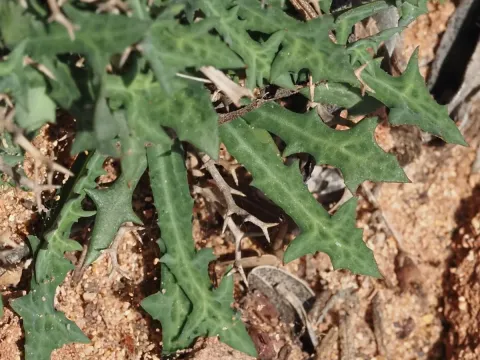
Launaea cervicornis
Launaea cervicornis
Launaea cervicornis is a notable member of the Asteraceae family, recognized primarily as an endemic succulent shrub native to the Balearic Islands. It has evolved into a compact, cushion-forming structure, which is a structural adaptation to harsh coastal environmental conditions.
What the section contains
Launaea cervicornis
The plant thrives in rocky, well-draining soils that are typically low in organic nutrients. In an agricultural or horticultural context, providing a substrate that mimics these stony conditions is essential to prevent physiological disorders.
Climate requirements for this species are centered around high levels of solar radiation and resistance to salinity. It is adapted to areas with long, dry seasons where water scarcity is the primary limiting factor for vegetation.
The botanical architecture of Launaea cervicornis, featuring its signature antler-shaped foliage, allows the plant to maintain turgor pressure despite low humidity levels. The leaves are thickened to store moisture, ensuring survival through prolonged heat waves.
Management of this culture requires minimal intervention. It does not require intensive fertilization, as excessive nutrient intake can disrupt its slow-growing, resilient growth pattern that characterizes its natural state.
The most significant threat to Launaea cervicornis in cultivation is the incidence of fungal pathogens, particularly those affecting the root system, which are triggered by overwatering.
Due to the presence of secondary metabolites such as latex in its tissues, the plant is relatively resistant to common agricultural pests that affect leafy vegetables.
In greenhouses, high humidity can cause the dense inner parts of the cushion to rot, emphasizing the need for a dry, well-ventilated environment.
Care must be taken to prevent infestations of mealybugs in the crevices between the stiff leaves, as these pests can be difficult to manage once established.
Protecting the plant from mechanical damage is also crucial, as the succulent branches are brittle and can break easily if mishandled during maintenance or transplanting.