
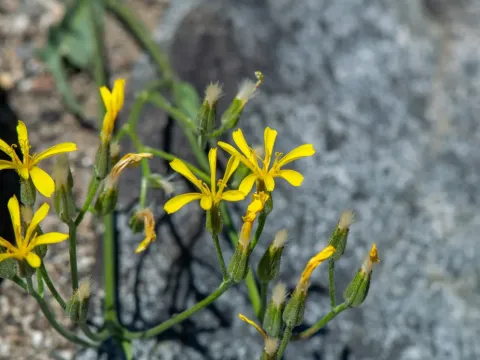
Longleaf hawksbeard
Crepis acuminata
Longleaf hawksbeard (Crepis acuminata) is a perennial herbaceous plant belonging to the Asteraceae family. It is recognized in agronomy for its adaptability to high-altitude environments and resilient forage properties.
What the section contains
Longleaf hawksbeard
The species is native to western North America, thriving in arid slopes and alpine meadows. Its natural habitat suggests that the plant is highly evolved to survive in soils with limited fertility and moisture.
Regarding cultivation requirements, the plant demands well-drained, porous soils. It prefers open areas with full sun exposure and is highly tolerant of the rocky, alkaline substrates frequently found in montane regions.
Botanically, Crepis acuminata is defined by its pointed lanceolate leaves and bright yellow, composite flower heads. These structures are designed for efficient pollination in windy, mountain-top conditions where insects are sparse.
For agricultural purposes, this plant is used to enhance the nutritional profile of grazing pastures. Its ability to regrow efficiently after grazing or mowing makes it an excellent candidate for semi-natural grassland improvement.
Like many members of the daisy family, longleaf hawksbeard can suffer from powdery mildew if humidity levels remain consistently high. Proper air circulation and avoid over-sowing are crucial for maintaining healthy crops.
Aphid infestations are the most common pest issue, typically targeting succulent new growth. Early identification is key to preventing the spread of these pests across the forage field.
Soil-borne larvae, including wireworms, can damage the root systems, leading to reduced vigor and stunted growth. Implementing a crop rotation strategy is the most effective way to manage these subterranean threats.
Occasional infestations of seed-eating weevils can impact the plant's natural reproduction cycle. While usually not a threat to the forage quality, it is important for growers interested in seed collection.
Generally, the plant is quite hardy, and many potential threats can be mitigated by keeping the stand density at an appropriate level. Maintaining a healthy soil ecosystem supports the plant's natural immunity.