
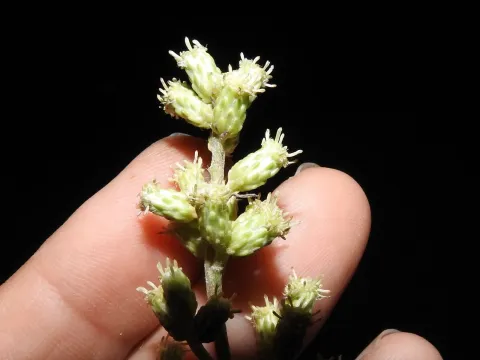
Baccharis spicata
Baccharis spicata
Baccharis spicata is a perennial semi-shrub belonging to the Asteraceae family. Native to South America, it naturally thrives in regions ranging from Brazil to Argentina, primarily inhabiting moist habitats and riverbanks where it can access consistent water sources for its rapid vegetative development.
What the section contains
Baccharis spicata
The plant prefers sunny locations with fertile, well-draining soils. While it exhibits a high tolerance for waterlogged conditions compared to other shrubs, it requires protection from severe frosts. In an agricultural context, it is best suited for climates with long, warm growing seasons.
Botanically, it features erect, branching stems covered with lanceolate, slightly serrated leaves. The unique inflorescences, appearing as spikes of tiny flowers, make it an attractive plant for pollinators, providing a significant boost to the local insect population which is vital for agricultural biodiversity.
For successful growth, soil should be kept moderately moist during the primary growth cycle. The plant responds well to organic fertilization and soil conditioning, especially if grown on marginal lands that require rejuvenation. Proper spacing is essential to ensure adequate airflow between plants to prevent humidity-related issues.
Propagation is typically done through cuttings, which ensures the genetic consistency of the crop. When establishing a new field, it is recommended to start during the early spring to allow the root system to establish before the onset of the peak heat of summer, ensuring higher survival rates.
Harvesting of Baccharis spicata is primarily focused on the aerial parts of the plant, which are collected during the peak flowering stage. This timing is critical to maximize the concentration of secondary metabolites, which are highly valued in traditional medicine and industrial applications.
Mechanical harvesting equipment can be used to trim the stems, followed by immediate drying. Drying should occur in a shaded, well-ventilated area to prevent the degradation of volatile compounds. Achieving the correct moisture content is vital for long-term storage and quality control of the biomass.
Beyond its therapeutic uses, the plant is increasingly recognized for its role in phytoremediation. Its ability to absorb excess nutrients and stabilize soil makes it an ideal candidate for buffer zones around agricultural fields, helping to prevent runoff into nearby water bodies.
The management of Baccharis spicata fields includes regular pruning after the harvest to stimulate fresh growth for the following season. This practice helps maintain the plant's vigor and prevents the accumulation of dry, dead material that could harbor pests or pathogens over the winter months.
Proper storage involves keeping the dried product in airtight containers in a cool, dry place. By maintaining strict quality standards throughout the harvest and post-harvest process, producers can ensure a high-value product suitable for the pharmaceutical and natural product markets.