
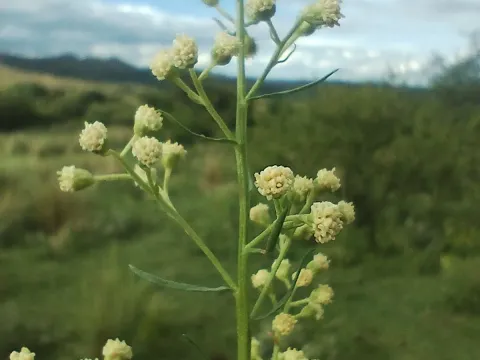
Baccharis coridifolia
Baccharis coridifolia
Baccharis coridifolia is a perennial subshrub belonging to the Asteraceae family. It is native to South American countries, particularly found in Argentina, Brazil, and Uruguay, where it often colonizes open fields.
What the section contains
Baccharis coridifolia
The plant thrives in well-lit, sunny areas with moderate soil drainage. It is commonly identified as a colonizer of degraded pastures and disturbed lands, where it outcompetes native grasses for nutrients.
Climatic requirements are centered around warm, temperate regions. Baccharis coridifolia is notably hardy and can withstand periods of drought, allowing it to persist in environments where other vegetation suffers.
Botanically, it is characterized by narrow, needle-like leaves and rigid, erect stems that grow up to 80 centimeters. The plant produces small flower heads, facilitating wind dispersal of its seeds across pastures.
There is no standard agricultural cultivation for this plant. Instead, it is classified as a harmful weed that poses a significant management challenge for farmers and landowners in South America.
The primary concern regarding Baccharis coridifolia is its potent toxicity to livestock. The plant contains macrocyclic trichothecene mycotoxins, which are highly lethal even in small quantities.
Cattle and sheep are at the highest risk of ingestion, especially during the dry season when the plant remains green and accessible while preferred forage is scarce. Symptoms of poisoning include severe digestive distress.
Pests and diseases are not typically a focal point for this plant, as agricultural efforts focus on eradication rather than preservation. However, some specific insects feed on its foliage in its native range.
Management strategies involve systematic mechanical control and the application of targeted chemical herbicides. Early identification is crucial to prevent the expansion of the weed population on farms.
Given the risks it poses to animal health, strict monitoring of grazing land is standard practice to ensure the safety of the herd and prevent economic losses in the pastoral sector.