
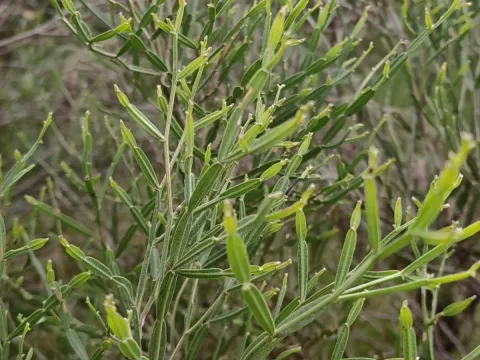
Baccharis articulata
Baccharis articulata
Baccharis articulata is a perennial subshrub belonging to the Asteraceae family. It is distinct for its jointed stems that perform photosynthesis, as the leaves are highly reduced or absent. This morphology is an adaptation to harsh environmental conditions.
What the section contains
Baccharis articulata
Native to South America, specifically Argentina, Uruguay, and Southern Brazil, the plant grows in open grasslands and scrublands. It is well-adapted to rocky and sandy soils, which are typical of its natural habitat in subtropical regions.
The plant thrives in locations with full sun exposure. In cultivation, it is essential to ensure a well-drained substrate, as Baccharis articulata is highly sensitive to root rot caused by prolonged waterlogging. It exhibits high tolerance to drought.
Agricultural management involves monitoring soil nutrient levels. While it is a hardy species, regular weeding in the early stages is necessary to allow the plant to establish its root system without competition from more aggressive local weed species.
Economically, this species is highly valued for its medicinal properties. The extract of the plant is widely used in traditional and modern herbal medicine for its hepatoprotective and digestive-aiding properties, containing active flavonoids and polyphenols.
The primary threats to this culture are fungal diseases, particularly those that target the root crown. Maintaining adequate spacing between plants and ensuring good ventilation are the best preventive measures against these pathogens.
Pests that commonly impact Baccharis articulata include aphids and various chewing insects. Integrated pest management strategies are recommended to maintain the quality of the harvested biomass without relying solely on chemical pesticides.