
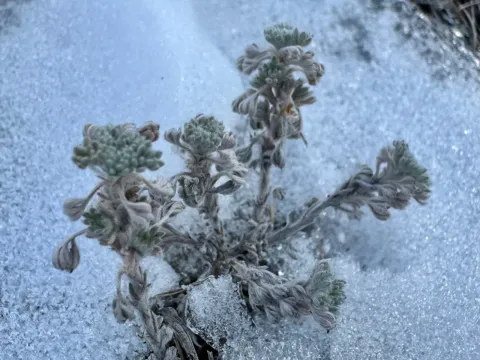
Fringed sagebrush
Artemisia frigida
Fringed sagebrush (Artemisia frigida) is a perennial subshrub belonging to the Asteraceae family. It is widely recognized for its high adaptability to harsh steppe environments, characterized by cold winters and dry, scorching summers.
What the section contains
Fringed sagebrush
The plant thrives in well-drained, nutrient-poor, and alkaline soils. It is particularly effective in colonizing stony slopes and disturbed lands, where it plays a key role in soil stabilization and preventing wind erosion in arid regions.
Its physiological resilience is largely due to its deep root system, which enables it to withstand prolonged moisture stress. The foliage is covered with fine, silky hairs that minimize transpiration, a classic evolutionary adaptation for water conservation.
Regarding light requirements, Fringed sagebrush necessitates full sun exposure for optimal growth and secondary metabolite production. Shaded conditions negatively impact the density of its silvery-green foliage and the concentration of its essential oils.
In agriculture, this plant serves as a vital forage resource for sheep and wild herbivores, particularly in late autumn when other grasses have withered. Furthermore, it is increasingly studied for its pharmacological properties, including antimicrobial and anti-inflammatory activities.
Due to its high concentration of essential oils, Fringed sagebrush is naturally resistant to a wide array of pests. However, under suboptimal cultivation conditions, the plant may become susceptible to opportunistic pathogens that exploit its weakened state.
Powdery mildew represents the most significant fungal risk, typically emerging in environments with poor air circulation or excessively high humidity. Affected plants exhibit a white, dusty coating on leaves, which reduces their overall vitality.
Some insects, such as aphids, can infest the tender tips of the branches during the vegetative phase. While they rarely cause crop failure, large populations can weaken the plant and serve as vectors for secondary fungal infections.
Root rot is primarily an issue in heavy, compacted soils where aeration is insufficient. Ensuring proper drainage is the most effective preventative measure against root pathogens for this species.
Effective management includes regular monitoring of plant health and promoting biodiversity around the plots to encourage natural predators. Chemical intervention should be avoided to maintain the purity and quality of the medicinal biomass produced.