
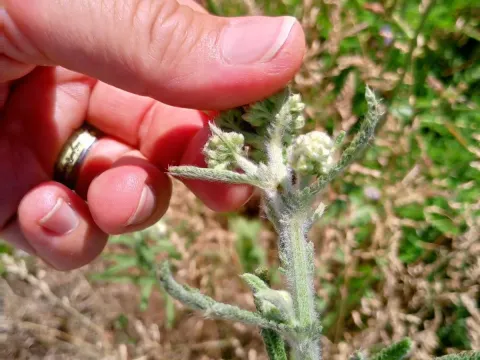
Achillea setacea
Achillea setacea
Achillea setacea, commonly known as bristle-leaf yarrow, belongs to the Asteraceae family. It is a perennial herbaceous plant valued for its resilience and pharmacological properties, often grown in specialized agricultural settings.
What the section contains
Achillea setacea
Sowing is typically performed in early spring or late autumn. The seeds are very small, requiring a firm, finely prepared seedbed to ensure proper soil-to-seed contact and uniform germination.
When seeding, a row spacing of 45 to 60 centimeters is recommended to facilitate mechanical weeding and ensure that the plants have sufficient space to develop their root systems.
The seeds should be covered with a very thin layer of soil, no more than 0.5 to 1 centimeter deep, as deep planting significantly reduces emergence rates.
Initial development is slow, with the plant spending the first year creating a robust basal rosette of leaves before shifting its energy toward stem elongation and flower production in subsequent years.
Achillea setacea is well-known for its extreme drought tolerance and ability to thrive in poor, rocky, or sandy soils where other crops would fail to produce significant biomass.
The plant prefers full sun exposure; shade results in spindly growth and a lower concentration of secondary metabolites, which are essential for its medicinal value.
It performs best in neutral to slightly alkaline soil conditions. Excellent drainage is non-negotiable, as the plant is highly susceptible to root rot if water remains stagnant in the root zone.
As a low-input crop, it requires minimal fertilization. Over-fertilization, especially with nitrogen, can lead to excessive foliage growth at the expense of floral development and medicinal compound density.
This species is highly adapted to continental climates, possessing a deep taproot that allows it to survive long dry spells while improving soil structure through its dense network of roots.
The harvested product consists of the aerial parts (stems, leaves, and flowers). Yields typically peak during the second and third years of establishment as the plants mature into dense stands.
In optimal conditions, producers can expect a dry yield ranging from 1.5 to 3 metric tons per hectare, depending on local climate, harvest timing, and soil fertility levels.
Timing the harvest is critical; the plants should be gathered when approximately 70-80% of the flowers are fully open, as this is when the concentration of essential oils and active ingredients is highest.
By implementing proper field management and preventing weed competition during the establishment phase, growers can maintain profitable yields for several consecutive seasons.
Post-harvest processing involves rapid drying to prevent fermentation, ensuring the medicinal quality remains consistent for industrial use in herbal supplements or pharmaceutical applications.
Fungal diseases such as powdery mildew represent the primary threat to Achillea setacea, especially in regions with high humidity or poor air circulation within the canopy.
Pests are generally not a major concern due to the plant's high content of bitter compounds and essential oils, which act as natural deterrents against many common agricultural insects.
In rare instances, aphids or leaf-feeding beetles may cause minor damage. Monitoring is essential during the spring flush to ensure that infestations do not reach critical levels requiring treatment.
Maintaining proper spacing and ensuring the site has a high degree of sun exposure and wind movement are the best preventive strategies against the development of bacterial or fungal leaf spots.
Crop rotation is recommended to prevent the buildup of soil-borne pathogens, even though the species is generally quite robust against most common field-level plant diseases.
Harvesting is conducted during the summer months when the plant is in full bloom. It is essential to perform the harvest during dry, sunny weather after the morning dew has completely evaporated.
The stems are cut at approximately 15-20 centimeters above the ground, ensuring the crown of the plant is not damaged, which allows for healthy regrowth in the following season.
Harvested material must be kept in thin layers or loose bundles during transport to prevent the heat buildup that causes wilting and degradation of active chemical components.
Drying is performed in dark, well-ventilated sheds to preserve the vibrant color of the flowers and the chemical integrity of the essential oils, avoiding direct sunlight at all costs.
Once dried to a crisp texture, the stems are cleaned, sorted to remove weeds or debris, and packed into breathable containers to maintain quality during storage and transport to buyers.